Prepare to build, secure, and manage the underlying frameworks of the next digital era, as well as meet the demands of the modern workforce, which shifting at an unprecedented rate. The global landscape of industrial and scientific fields is becoming more technology driven. Learn to meet these demands by integrating deep technical expertise with cross-disciplinary experimentation through degree programs in the College of Tech Futures at Illinois Tech.
What is the Academic Focus of the College of Tech Futures?
Learn more about the associated Tech Futures schools:
Explore key specializations in artificial intelligence, cybersecurity, data science, engineering, health technology, life sciences, and applied research.
Understand how data-driven innovation in one field can drive technical breakthroughs in another through degree programs that integrate physical sciences, life sciences, and biomedical technologies with advanced software engineering and applied mathematics.
See how fundamental science directly applies to real-world deployment in a college that is purposefully structured to dissolve traditional academic silos. Combine rigorous technical depth with scalable societal impact at the primary scientific and computing core of Illinois Tech. Spanning two expansive schools, the college encompasses everything from ABET-accredited engineering paths and fundamental physical sciences to cutting-edge computing degrees—including the Midwest's first Bachelor of Science in Artificial Intelligence.
How Does the College of Tech Futures Prepare Students for Technology Careers?
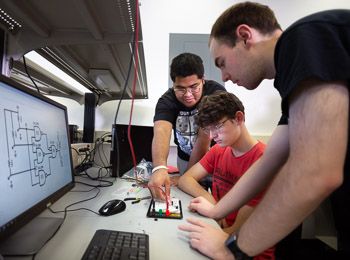
Education within the College of Tech Futures is anchored by hands-on research, technical laboratory analysis, and industry-aligned product development supported by Illinois Tech’s Elevate initiative. Students gain deep fluency in high-demand technical sectors, learning to deploy machine learning algorithms, manage global database networks, secure digital infrastructure, engineer smart grids, and develop life-saving medical devices or sustainable food systems. This immersive framework translates quantitative logic into strategic leadership capital. Graduates step into the workforce equipped with the precise engineering competencies, computational skills, and quality-assurance capabilities required to lead technical teams across global technology firms, defense sectors, clinical networks, and premier research facilities such as Argonne National Laboratory and Fermilab.