Drone-Delivered Network Connection
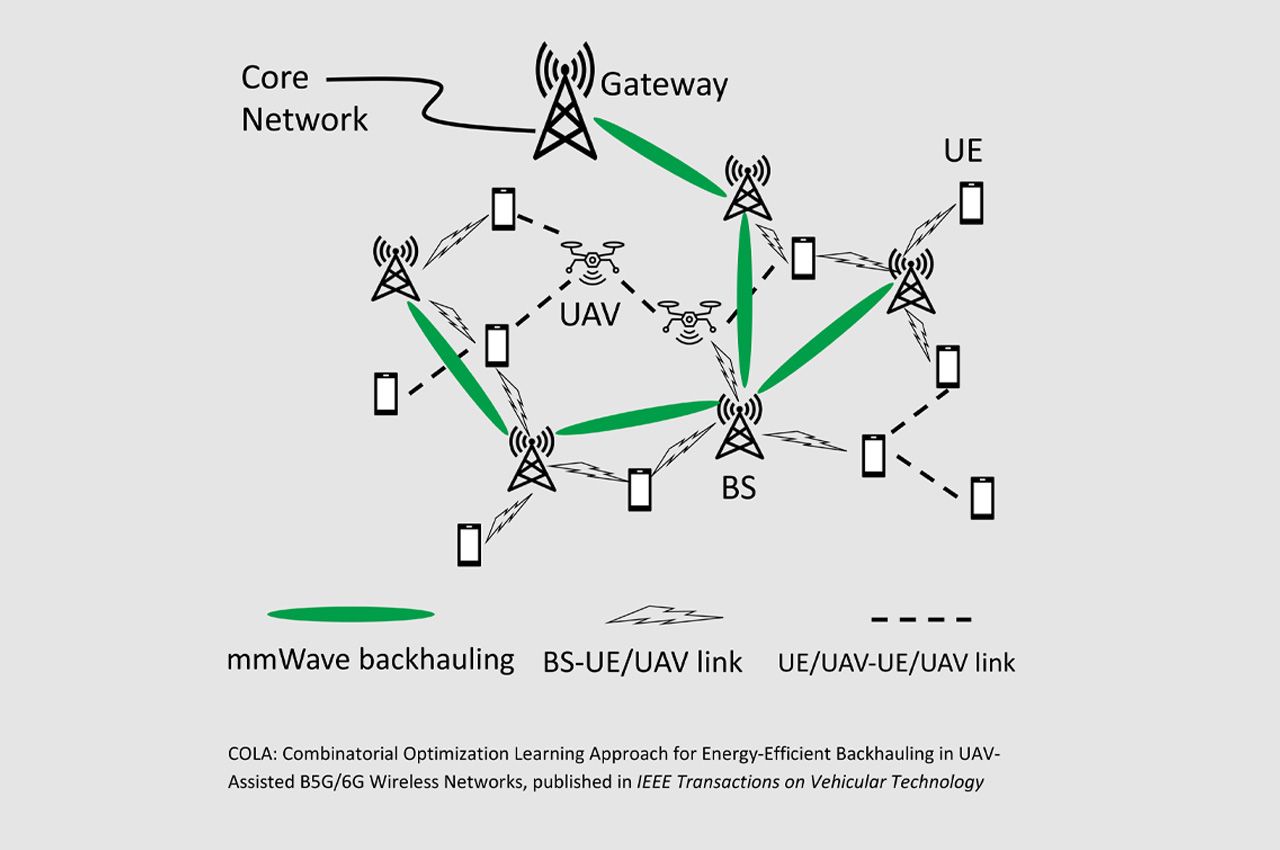
As more devices are designed to connect to the internet, from phones and watches to doorbells and thermostats, network service providers must figure out how to handle the bandwidth of an exponentially growing number of devices. One possible solution is to use unmanned aerial vehicles (UAVs or drones) as base stations that can be easily deployed to a roof or lamppost to flexibly and dynamically change the network bandwidth nearby.
In a paper published in IEEE Transactions on Vehicular Technology, Illinois Tech Professor of Electrical and Computer Engineering Yu Cheng and his students explored this possibility.
“The goal is to serve the user so that you can get good quality service anytime, anywhere,” says Cheng.
Currently, most network coverage happens through fixed base stations—towers that use a lot of power to provide coverage to a large surrounding area.
These towers are large investments that are fixed in place, only providing reliable coverage to users that are in their zone. They must be built to be able to handle the largest expected capacity of that area, and they lack the flexibility to adjust that capacity to usage needs.
By deploying drones instead, network capabilities can adjust to demand, providing more reliable coverage and reducing wasted resources by increasing or decreasing available network coverage in a way that responds to demand at a given time.
The technology already exists to implement this idea; the main challenge comes in figuring out how to deploy the drones.
“How many UAVs should be deployed?” says Cheng. “If the number is too large, we unnecessarily waste energy, and if it’s too small, we won’t have enough spectrum to support users, so we want to find the optimal number.”
Cheng’s method uses machine learning to jointly consider the number of drones deployed and where those drones would be deployed to, finding the solution that covers service needs in the most efficient way.
Traditional methods for solving this type of problem rely on approximations and could take a long time to compute. Cheng has combined two cutting-edge machine-learning techniques to develop an algorithm that quickly finds the optimal solution.
“Our method can be a very powerful solution for this category of combinatorial optimization problems,” says Cheng.
The machine-learning algorithm was trained on optimized network results that were obtained through traditional methods.
Since the computation can be done quickly, it would allow network providers to flexibly adjust coverage over the course of a week or even a day.
Cheng says that he expects some version of this idea to become reality within the next five years.
“It’s similar to having UAV deliver things. Right now, it’s being done on a small scale and is still in the experimental stage, but theoretically, everything is doable,” says Cheng.
He plans to continue to work on the algorithm’s performance and hopes to find industry partners to work with to make sure that the development aligns with practical needs.
Oluwaseun T. Ajayi (M.S. ECE ’24, Ph.D. EE Candidate) and Suyang Wang (M.S. EE ’17, Ph.D. EE ’24) contributed to this research.
Image: Diagram showing user equipment connected to internet through fixed base stations and UAV base stations.