

From Buildings to Bylines to Bias
Finding Your Calling
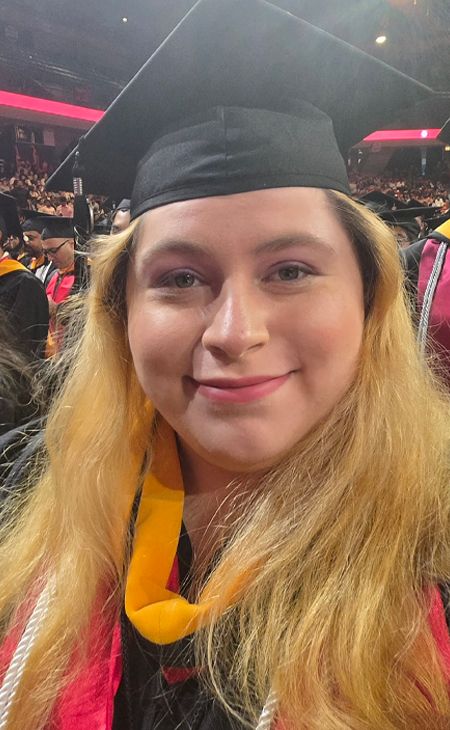
Kris Shiflet’s path at Illinois Tech began in architecture but ultimately led to a Ph.D in Industrial-Organizational Psychology, guided by a passion for problem solving and human behavior. Their leadership at Tech News shaped a sense of purpose and community and is now fueling their research on disability inclusion in the workplace.
Kris Shiflet (PSYC, M.S. IPSY ’25, Ph.D. IPSY 1st Year)When Kris Shiflet (PSYC, M.S. IPSY ’25, Ph.D. IPSY 1st Year) arrived at Illinois Tech in fall 2019, Chicago felt enormous in all the right ways. The city’s constant motion, the roar of the Chicago Transit Authority’s “L” train, and skyscrapers stretching overhead made a perfect backdrop for the aspiring architect.
But it didn’t take long for that vision to shift. A semester in, Kris realized that architecture wasn’t the fit they had imagined. When the COVID-19 pandemic shut down campus in spring 2020, the stress of a major that felt wrong collided with a campus community suddenly reduced to screens and virtual meetings.
Cut off from friends and the energy of campus life, Kris found comfort in one constant: Tech News. Throughout the isolation of the early stages of the COVID-19 pandemic, they served as layout editor for the university’s student-led and student-run newspaper, and the unexpected pause of the pandemic offered space to reassess what they truly cared about.
Already thinking about changing their major, Kris explored fields that called out to them.
“I was leaning into humanities and communications,” Kris says. “I eventually settled on psychology because I really enjoyed the problem solving that goes into it.”
That decision reshaped their entire path. Today, Kris has earned a bachelor’s degree in psychology, a master’s degree in industrial-organizational psychology, and has fully stepped into their next chapter as a Ph.D. student in I-O psychology. Some of what drew Kris to I-O psychology runs in their family—their mother works in organizational development—but the field resonated with them immediately.
“Once I started taking those courses and meeting the people in that department, it really settled in that this was where I was supposed to be,” Kris says.
That sense of belonging extended far beyond the classroom. Over five years, Kris became a central presence in student life through their work at Tech News, where they eventually served as editor in chief after joining the staff as a first-year student. The newsroom became both a training ground and a tight-knit community.
“The biggest thing for me was becoming more adaptable,” Kris says of what leading the newspaper taught them. “I got a real sense of how diverse the school is, not just in terms of demographics, but in terms of the passions and interests everyone brings to the table.”
One of the accomplishments Kris is most proud of is building a team that cared deeply about the work that they created together.
“We got to a place where the people who are involved really want to be involved and are passionate about being involved,” Kris says. “It was such a relief to be able to leave it in the hands of people who are really, truly passionate about journalism and Illinois Tech and the newspaper.”
That theme—finding the right people, the right environment, and the right purpose—is a constant thread throughout Kris’s journey.
“I can’t describe how amazing it feels to know you are in the right place, to know that you found your calling in life,” Kris says.
Community helped make that possible. The friends Kris met in their first year are still the people they live with today. Their I-O psychology cohort is small but close-knit, and the connections made through Tech News and student government still feel like family.
As they begin their Ph.D., Kris is channeling that sense of purpose into research that challenges the field of I-O psychology to better include—and listen to—disabled people.
“I’m really interested in disability inclusion and acceptability,” Kris says, noting a desire to explore whether people perceive legally protected supports as fair or unfair. “A lot of research and practice around stuff such as DEI has largely excluded disability—I want to change that. I want to look at how folks react to disabled folks using accommodations in the recruiting process.”
Ultimately, Kris hopes their work broadens the field’s understanding by elevating voices that have too often been overlooked.
“So much of the research has been with disabled people as research subjects and not necessarily people who are experts on their own lives,” Kris says. “I want to bring in their perspectives.”