

Data Sets from the Diamond
Baseball Meets Big Data at Sabermetrics Seminar
Carson Vrba put his classwork to practice by analyzing baseball statistics, which he will present at a big-league sabermetrics seminar.
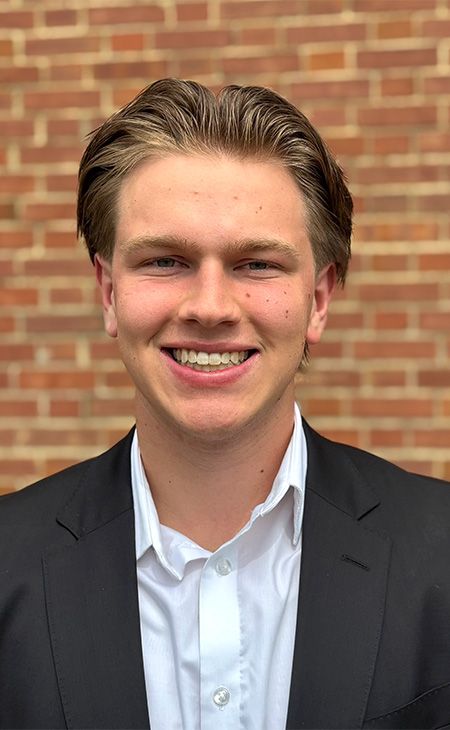
Carson Vrba (STAT, M.A.S. DS 4th Year)Carson Vrba (STAT, M.A.S. DS 4th Year) has been able to combine his passions for baseball and statistical analysis at Illinois Tech, which led to an invitation to present his research at a prominent baseball statistics seminar this August.
He says playing for the Illinois Tech baseball team pushes him to be better on the field to support his teammates. That desire to continuously improve translates to higher standards in his classroom work.
“As a member of the team, it always feels like I am a part of something more than myself, and I always try to be better to help the team,” Carson says.
Carson brought his enthusiasm for baseball into the classroom by applying his mathematical knowledge into statistical analysis. He began researching stolen bases in Northern Athletics Collegiate Conference baseball, the athletic conference that the Illinois Tech baseball team is a member of.
The goal of the project is to find out whether stealing a base is worth the risk.
“In Major League Baseball, it is not worth it,” he says of stealing bases. “An ordinary least squares model tells us that it isn’t worth it in NACC baseball either.”
His research earned him an invitation to the 2026 Sabermetrics, Scouting, and the Science of Baseball seminar hosted on Illinois Tech’s campus, which features MLB and NCAA scouts, academics, statisticians, and stats-driven members of the media.
Carson says the mathematical knowledge he accrued in the classroom was great preparation for sports analytics, specifically the combination of coding and modeling coursework.
“Conducting this research has allowed me to really understand what I want to do with my future—to land a role in the sports analytics field,” he says. “Educationally, it has helped me apply skills I learned in the classroom.”
Carson credits Professor Fred Hickernell’s feedback on his research to bring it to where it is today. Hickernell provided guidance on which formulas and models Carson needed to help conduct the research.
“I was able to reach my original conclusion using an ordinary least squares model,” he says. “Professor Hickernell then suggested that I look into a principal component analysis model. This allowed me to expand my search and reach deeper conclusions.”