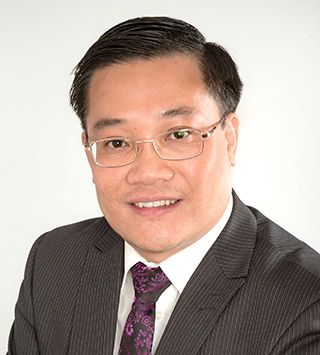
Qing-Chang Zhong
- Professor Emeritus
Power systems are undergoing a paradigm shift: grids long dominated by a relatively small number of large synchronous generators are becoming networks of millions of smaller, distributed power-electronic resources and flexible loads. Qing-Chang Zhong has addressed the resulting fundamental challenges of compatibility, stability, and scalability through an integrated system-level solution that helps accelerate clean-energy adoption and meet ambitious global grid-decarbonization targets. He invented the Synchronized-and-Democratized (SYNDEM) architecture and pioneered its enabling virtual synchronous machine (VSM) technologies, establishing a unified physics-based foundation for autonomous, stable, and resilient power-electronic grids.
Zhong then built a worldwide engineering movement around this direction through more than 200 invited lectures in more than 20 countries and sustained engagement with utilities, industry, and public institutions. He has delivered a rare end-to-end contribution to engineering science and practice: a field-defining system architecture and its enabling technologies, reinforced by rigorous system-level theory and field-shaping scholarship; extended through successive generations of technology development; advanced through global field leadership and institutional transformation; influenced policy and regulatory development; anticipated and addressed engineering needs that years later emerged as major United States federal research priorities; validated in large-scale physical systems and field tests; advanced to utility scale after his United Kingdom-based technical leadership convinced State Grid Corporation of China of the strategic importance of VSM technology and established the institutional foundation for State Grid to designate it as one of its Ten Key Science and Technology Innovation Projects, independently implement and commission the 140 MW Zhangbei VSM demonstration, and subsequently publish field results; institutionalized globally through his initiation of IEEE Std 2988-2024 and leadership of its development; diffused through education and workforce development; and translated into practice through licensing and founding a startup with commercial products sold to customers in more than 10 countries.
The significance of this work has been recognized across scientific, engineering, policy, and public forums. He delivered the sole lecture on power systems among the eleven plenary and semi-plenary lectures at the 2017 IFAC World Congress, held to mark IFAC’s 60th anniversary. Additionally, SYNDEM and VSM technologies were cited in the 2018 U.S. House hearing, “The Electric Grid of the Future” and IEEE Spectrum featured the work in 2013, 2017, and 2025, with Canary Media describing it as a “game changer for grid.” Most notably, the American Association for the Advancement of Science elected Zhong to its 2025 class of fellows “for inventing the Synchronized-and-Democratized (SYNDEM) architecture by merging synchronization principles in natural sciences and democracy concepts in social sciences, and for pioneering Virtual Synchronous Machines (VSM) technologies to revolutionize power systems.”
Zhong is also an AAAS fellow (2025 class), IEEE fellow (2017 class), and IET fellow (2010 class).
Education
Ph.D., Electrical and Electronic Engineering, Imperial College London, United Kingdom, 2004.
Ph.D., Automation, Shanghai Jiao Tong University, China, 2000.
M.Sc., Electrical Engineering, Hunan University, China, 1997.
B.Eng., Electrical Engineering, Hunan Institute of Engineering, China, 1990.
Research Interests
Zhong is the Max McGraw Endowed Chair Professor in Energy and Power Engineering and Management at Illinois Institute of Technology and the founder and chief executive officer of Syndem LLC. Before moving to the United States in 2014, Zhong established a distinguished academic career in the United Kingdom, culminating in his appointment as Chair Professor of Control and Systems Engineering at the University of Sheffield and in the formation of the foundational SYNDEM architecture and VSM technology framework. At Sheffield, he established a $5M+ research laboratory dedicated to the control of energy and power systems, with support from organizations including Rolls-Royce, National Grid, National Instruments, Texas Instruments, Siemens, ALSTOM, Turbo Power Systems, Chroma, Yokogawa, OPAL-RT, and others. A researcher, educator, inventor, and entrepreneur, he integrates systems science, control theory, power electronics, power systems, hardware engineering, and technology translation. His body of work—including four research monographs, more than 250 peer-reviewed publications, and a patent portfolio comprising eight U.S. patents and 17 foreign patents, with seven inventions protected in both U.S. and foreign jurisdictions—has reshaped how power-electronic grids are conceived, controlled, coordinated, and implemented, addressing one of the defining global challenges of the twenty-first century: creating stable, coordinated, and resilient energy systems that advance energy freedom and equity.
SYNDEM: A Field-Defining Architecture for Power-Electronic Grids
Zhong’s most transformative contribution is his invention of SYNDEM—a field-defining architecture that integrates synchronization principles in the natural sciences with democracy concepts in the social sciences—as detailed in his sole-authored IEEE paper and Wiley–IEEE research monograph. Democratization gives many participants freedom, but not the common physical rule needed for stable coordination or consensus—a limitation illuminated by Nobel Laureate Kenneth Arrow’s Impossibility Theorem. SYNDEM supplies that rule by making the synchronization mechanism of synchronous machines, which has underpinned power-system operation for more than a century, the common physical law for heterogeneous conventional and power-electronic resources.
Under SYNDEM, conventional and renewable generation, network converters, energy storage, electric vehicles, and, critically, flexible loads are unified within a common framework and can equally participate in voltage and frequency regulation according to their capacity. This creates a backward-compatible universal interface through which power-electronic resources can work with the existing synchronous-machine-based grid, while supply-, network-, and demand-side converters become active participants in system stability. Flexible loads can provide continuous primary frequency and voltage response instead of only binary load shedding, mobilizing flexibility and stored energy already present in motors, vehicles, storage, and other devices.
SYNDEM also separates physical coordination from digital supervision. Synchronization and low-level stability arise through electrical interaction without depending on continuous high-speed communication or a central controller, providing a communication-independent layer of decentralized cyber-physical grid security against external telecommunications disruption or manipulation; digital systems remain essential for monitoring, management, markets, and optimization, and can provide optional supervisory set-points. Through energy bridges, SYNDEM enables local systems to black-start, regulate voltage and frequency, merge, island, recover, resynchronize, and reconnect autonomously—supporting scalable self-organization while containing disturbances and reducing cascading-failure risk.
Pioneering and Field-Shaping Virtual Synchronous Machine Technologies
To implement SYNDEM, Zhong pioneered VSM technologies that enable power-electronic converters to behave as grid-forming synchronous machines. Earlier VSM approaches such as VISMA used synchronous-machine models to generate current references, leaving the converter as a controlled current source dependent on an existing grid voltage. Recognizing that power systems are organized around voltage sources, Zhong invented the synchronverter by embedding synchronous-machine equations directly into converter-voltage generation. The synchronverter was the first practical, experimentally validated voltage-controlled VSM—a grid-compatible voltage source capable of forming its own waveform and regulating active and reactive power—and redefined the field. The seminal synchronverter paper ranks among the three most-cited non-survey papers in the 44-year history of IEEE Transactions on Industrial Electronics, with nearly 4,000 Google Scholar citations as of June 29, 2026.
Building on this breakthrough, Zhong drove successive generations of VSM technology. His 2014 paper on self-synchronized synchronverters demonstrated an inherent synchronization mechanism through electrical interaction without measuring grid frequency or using a dedicated phase-locked loop, eliminating the separate synchronization unit then widely regarded as necessary. By making synchronization intrinsic to converter control, this work is setting a new industry norm for converter-dominated power systems. He also identified and corrected three fundamental weaknesses of conventional droop control and invented robust droop control for accurate proportional power sharing and tight voltage and frequency regulation despite component mismatches. He then developed universal droop control to enable the parallel operation of converters with different impedance characteristics. By revealing the structural relationships among droop-controlled converters, VSMs, and phase-locked loops, he provided a mathematical foundation for inherent self-synchronization and established universal robust droop control as a second-generation VSM technology. The self-synchronization paper ranks among the top 30 most-cited non-survey papers in the 40-year history of IEEE Transactions on Power Electronics, with 1,350+ Google Scholar citations as of June 29, 2026; the robust-droop control paper had more than 1,100 Google Scholar citations as of the same date.
Zhong’s invited, sole-authored 2016 IEEE Power Electronics Magazine cover story, “Virtual Synchronous Machines: A Unified Interface for Grid Integration,” synthesized the synchronverter and related developments into a coherent framework. It ranked among the magazine’s two most-cited and two most-popular papers as of June 2026 and was recognized as its Top Paper of 2016. His subsequent advances introduced bounded voltage and frequency, impedance shaping, current limiting, and reconfigurable inertia and damping.
Together, this sustained sequence of inventions and field-shaping scholarship transformed VSMs from a machine analogy into a robust, interoperable, and scalable technology family that enables the SYNDEM architecture.
Scalable Mathematical Foundations for System-Level Stability
As lead author, Zhong established scalable mathematical foundations for passive converter control and network-wide stability in converter-dominated power systems. The 2022 IEEE Transactions on Automatic Control paper developed a port-Hamiltonian framework that makes grid-tied or islanded converters behave as VSMs and renders the closed-loop system passive without assuming constant frequency, voltage, or loads. The 2024 CSEE Journal of Power and Energy Systems paper integrated port-Hamiltonian systems theory with fundamental circuit theory to develop compact, scalable modeling and control frameworks for converter-dominated power systems with an arbitrary number of converters, passive controllers and loads, and meshed passive transmission and distribution lines. Both the controlled converters and the resulting systems are passive and input-to-state stable, showing that local passivity and stability guarantees can be composed across the network for SYNDEM grids of arbitrary scale.
Global Field Leadership: Institutional Transformation and Policy Impact
Soon after inventing the synchronverter in 2008, while based in the United Kingdom, Zhong launched a global initiative to build worldwide technical and institutional momentum around the emerging VSM direction. Through more than 200 invited lectures in more than 20 countries and sustained engagement with universities, research centers, utilities, industry, and public institutions, he advanced the SYNDEM architecture and its enabling VSM technologies from foundational invention and research into a global engineering direction. The initiative unfolded through complementary pathways: technical and institutional transformation culminating in utility-scale demonstration in China; multidisciplinary field building, policy engagement, and federal technology development and validation in the U.S., followed by convergence with major national research priorities; regulatory translation in Great Britain; and global standardization through IEEE Std 2988-2024.
The clearest institutional transformation within this initiative occurred at State Grid Corporation of China. During his earlier UK-based career, after inventing the synchronverter in 2008, Zhong introduced and championed VSM technology through dozens of lectures in China, convinced State Grid of VSM technology’s importance and secured State Grid funding for a dedicated collaborative project between the China Electric Power Research Institute (CEPRI) and the University of Sheffield, and led the dedicated VSM project team at CEPRI beginning in 2012. Zhong moved to the U.S. in August 2014, and the UK-based collaboration later concluded after the project was completed. The technical and institutional foundation he had established proved decisive in State Grid’s subsequent decision to designate VSM technology as one of its Ten Key Science and Technology Innovation Projects and undertake a utility-scale VSM demonstration. His invention, advocacy, program initiation, and technical and institutional leadership converted an original research direction first into State Grid’s institutional commitment and then, through State Grid’s independent implementation and commissioning, into the 140 MW Zhangbei VSM demonstration, with field results subsequently published by the implementing organizations.
A complementary institutional and policy pathway unfolded in the U.S. Years before grid-forming technologies became a consortium-scale U.S. federal research category, Zhong had already articulated the underlying direction and begun building U.S. institutional momentum through his global initiative. An early U.S. component of the initiative was a UK-funded international sabbatical that he initiated in October 2010 and undertook in 2012–2013. He visited and delivered lectures on the architecture and its enabling VSM technologies at three NSF-established Engineering Research Centers: Center for Power Electronics Systems (CPES), Future Renewable Electric Energy Delivery and Management Systems Center (FREEDM), and Center for Ultra-wide Area Resilient Electric Energy Transmission Networks (CURENT); one NSF Industry–University Cooperative Research Center: Grid-Connected Advanced Power Electronic Systems (GRAPES); two U.S. national laboratories: National Renewable Energy Laboratory (NREL) and Oak Ridge National Laboratory (ORNL); and approximately 20 leading U.S. universities. In September 2013, IEEE Spectrum reported his proposal for completely self-controlled power systems with millions of active participants, autonomous voltage and frequency regulation, and no central coordination. After moving to the U.S., he progressively advanced this direction through technical synthesis, policy engagement, multidisciplinary field building, federal technology development, and global standardization. His invited, sole-authored 2016 cover story framed VSMs as “A Unified Interface for Grid Integration.” In 2017, Michael Pesin, then Deputy Assistant Secretary at the U.S. Department of Energy, invited Dr. Zhong to DOE headquarters for focused technical discussions on SYNDEM and VSM technologies and stated, “Sooner or later, this will be deployed worldwide.” In 2018, the SYNDEM architecture and VSM technologies were cited in the U.S. House hearing “The Electric Grid of the Future,” bringing their implications for grid resilience and energy independence into the congressional record.
In early 2019, Zhong initiated and secured NSF support for and chaired a Workshop on Power Electronics-Enabled Operation of Power Systems, held at Illinois Tech from October 31–November 1, 2019. It convened the control, power-electronics, and power-systems communities and attracted more than 130 participants from government agencies, regulatory commissions, utilities, industry, research organizations, and universities. The NSF also awarded a planning grant led by him for a proposed Engineering Research Center for Communication-network-free, Autonomous, Renewable Electric Power Systems (CARE), active from September 2019–August 2020. In November 2019, DOE announced an award to Syndem for a project led by Zhong on autonomous grid-forming inverters enabled by always-on universal droop control without external communication or phase-locked loops. The project began in February 2020. Together, these NSF- and DOE-supported initiatives demonstrate his leadership in convening the field, advancing a center-scale research vision, and developing communication-network-independent autonomous power systems.
In December 2020, while Zhong’s DOE project was underway, DOE issued a funding opportunity to establish a $25 million Grid-Forming Technologies Research Consortium. On January 22, 2021, Zhong initiated the IEEE VSM standardization project, and on March 31, 2021, DOE invited him to present “Next-Generation Smart Grids: Autonomous Power Systems” to policymakers and senior engineering leaders, including C. D. Mote Jr., former President of the National Academy of Engineering.
In August 2021—13 years after he invented the synchronverter, eight years after IEEE Spectrum featured his proposal for completely self-controlled power systems with millions of active participants, and five years after his 2016 cover story framed VSMs as “A Unified Interface for Grid Integration”—DOE selected and funded the $25 million Universal Interoperability for Grid-Forming Inverters (UNIFI) Consortium to develop universal guidelines for seamless integration of inverter-based resources. Nearly another four years later, in January 2025, DOE’s Advanced Research Projects Agency–Energy announced the $30 million Grid Reliability with Automatic Damping and Inertia for Electrical Networks and Transmission Systems (GRADIENTS) program to advance grid coordination, protection, real-time control, stability, and resilience.
These landmark federal initiatives demonstrate that a unified interface for grid integration and the associated needs for interoperability, automatic damping and inertia, autonomous synchronization, coordinated control, and grid stability—an engineering direction Zhong had articulated and advanced for many years through the SYNDEM architecture and its enabling VSM technologies—subsequently emerged as major U.S. federal research priorities. This chronology underscores his engineering foresight and the enduring significance of the direction he defined and pioneered.
Great Britain served both as the original base of his global initiative and, later, as a distinct pathway of regulatory impact. Through sustained engagement with National Grid Electricity System Operator, now the National Energy System Operator, and participation in its VSM Expert Group, Zhong contributed to the technical foundation for Grid Code modification GC0137, which established a specification for grid-forming capability.
Taken together, these complementary pathways within the global initiative Zhong started while based in the United Kingdom—the State Grid pathway in China, the field-building and NSF–DOE pathway in the United States, the grid-code pathway in Great Britain, and the global standardization achieved through his initiation of IEEE Std 2988-2024 and leadership of its development—demonstrate his sustained global field leadership.
Validating SYNDEM Across Scales: Hardware and Field Demonstrations
The global initiative was grounded in engineering proof. Zhong validated SYNDEM and its enabling VSM technologies across physical systems, field tests, commercial operation, and independent utility-scale demonstration.
He established the world’s first 100-percent-power-electronics-based SYNDEM smart-grid testbed, in which eight heterogeneous physical VSM nodes were connected to a common AC bus and collectively regulated voltage and frequency without ICT-based low-level coordination. Presented in his semi-plenary lecture at the 2017 IFAC World Congress, featured by IEEE Spectrum and Canary Media, and documented in his 2020 Wiley–IEEE research monograph, it provided architecture-level physical proof that a fully converter-based grid could coordinate autonomously under SYNDEM.
Validation then advanced from an autonomous six-VSM renewable home grid integrating solar, wind, storage, and utility-grid interaction to field tests of 20 VSM-equipped converters with solar panels, batteries, and the utility grid under grid-connected and islanded conditions, as part of a U.S. Department of Energy-supported program. At system scale, Texas Tech’s reconfigurable SYNDEM Smart Grid Testbed, comprising 108 physical power converters, provides infrastructure for system-level validation, resilience research, and workforce development.
The autonomous operation of Syndem’s five commercial VSM units further demonstrates repeatable SYNDEM behavior, including black-start, voltage and frequency regulation, grid detection, self-synchronization and connection, islanding, and resynchronization and reconnection.
Validation also reached utility scale. The technical and institutional foundation Dr. Zhong established during his U.K.-based career as part of his global initiative proved decisive in State Grid Corporation of China’s subsequent decision to pursue VSM technology at utility scale. In 2017, State Grid, the world’s largest utility, independently implemented and commissioned the 140 MW Zhangbei utility-scale VSM demonstration, comprising 59 wind turbines totaling 118 MW, 24 photovoltaic inverters totaling 12 MW, and two five MW station-level VSM units. Reported at the time as the world’s largest VSM demonstration, Zhangbei provided independent utility-scale validation of the broader VSM direction that Zhong had pioneered and defined, with field measurements demonstrating critical virtual inertia (synthetic inertia) and robust fault ride-through capabilities in the transmission-connected project.
Renewable Home Grid
Six VSMs coordinate rooftop solar, wind, storage, and utility-grid interaction.
DOE-Supported 20 VSM Field Tests
Twenty VSM-equipped converters operate with photovoltaic panels, batteries, and the utility grid.
Texas Tech 108-Converter SYNDEM Testbed
A reconfigurable physical platform for system-scale testing, research, and workforce development.
Five Commercial VSM Units
Five manufactured units demonstrate coordinated operation as a product-scale system.
Global Standardization of VSM Technologies: IEEE Std 2988-2024
Zhong initiated IEEE Std 2988-2024 and chaired the working group that developed it from ideation through publication. Completed nine months ahead of schedule with 97 percent approval, it became the first global standard dedicated to virtual synchronous machines. It defines their fundamental principles and essential and optional functions for single-unit, multi-unit, islanded/off-grid, and grid-tied operation, providing a common framework for standardizing power-electronic converters across applications, integrating distributed energy resources at scale, and advancing energy freedom and access.
The working group included participants affiliated with GE, Siemens, Hitachi, ABB, Eaton, Schneider Electric, NERC, EPRI, ERCOT, MISO, Southern California Edison, National Grid, Energinet, and CLP Power Hong Kong. Their participation demonstrates that VSM technologies have moved beyond an academic specialty into a shared engineering framework spanning manufacturers, research and reliability organizations, system operators, and utilities. Approved in 2024 and published in 2025, IEEE Std 2988-2024 institutionalized VSM technologies globally, carrying Zhong’s work from pioneering invention and field-shaping scholarship through physical validation and utility-scale demonstration into global technical consensus and engineering practice.
Commercialization and Engineering Translation
Zhong has translated successive generations of VSM technology into engineering practice through two distinct commercialization routes. During his UK-based career, the synchronverter patent family was licensed to Synvertec for commercialization of first-generation VSM technology. Synvertec subsequently attracted public and private support from Horizon GreenTech Ventures, Israel Electric Corporation, the Israeli government, and the European Union’s Horizon 2020 program, creating an independent commercialization pathway for the foundational invention.
In 2017, Zhong founded Syndem LLC in the greater Chicago area to develop and commercialize later-generation VSM technologies, including second-generation VSMs based on universal robust droop control, and to extend SYNDEM into products, manufacturing, field validation, education, licensing, and partnerships. Syndem has carried out technology development and validation through four federally supported projects, completed DOE-supported field tests involving 20 VSM-equipped converters, and established in-house capabilities to design, test, and manufacture converters up to 20 kW. As an industry partner in a DOE-supported project led by Binghamton University and involving Brookhaven National Laboratory, Syndem manufactured and delivered 30 VSM units.
Syndem’s reconfigurable and reprogrammable Smart Grid Research and Educational Kits have been adopted by institutions in more than 10 countries, while its VSM products have been sold to customers in three countries. Cumulative product sales exceeded $1.6 million as of June 2026. In March 2026, OPAL-RT and Syndem announced a strategic partnership for joint marketing, integration, and sales, combining real-time simulation and hardware-in-the-loop testing with VSM products and reconfigurable physical hardware to provide an end-to-end pathway from modeling to experimental validation.
Together, the Synvertec and Syndem routes demonstrate sustained translation from foundational invention through licensing, federally supported development, field testing, manufacturing, customer delivery, international sales, and an expanding engineering ecosystem. The two routes remain technically and institutionally distinct: Synvertec pursued commercialization of licensed first-generation VSM (synchronverter) technology, while Syndem develops later-generation VSM technologies. Syndem’s operations are also institutionally separate from Zhong’s academic activities at Illinois Tech.
Global Field Building: Education and Workforce Development
Zhong has built a global community around SYNDEM and VSM technologies through sustained international lecturing, scholarly resources, hands-on education, technical training, competitions, workshops, and mentorship. He has delivered more than 200 invited lectures in more than 20 countries, including 26 plenary and keynote talks, and has been appointed a distinguished lecturer by the IEEE Control Systems, Power Electronics, and Power and Energy Societies. He has authored four research monographs and organized 14 workshops and tutorials at major international conferences. He developed reconfigurable and reprogrammable SYNDEM Smart Grid Research and Educational Kits to enable hands-on education and research; the kits have been adopted by institutions in more than 10 countries.
He established VSM as one of the two topics of the 2015 IEEE International Future Energy Challenge, attracting 12 proposals from six countries and culminating in hardware testing by seven finalist teams and an 80-plus-person workshop. He also led a 2019 National Science Foundation workshop that convened more than 130 participants from government, industry, utilities, research organizations, and universities.
During his UK-based career, Zhong mentored doctoral students who received the IET Control and Automation Doctoral Dissertation Award and Chinese National Awards for Outstanding Students Abroad, including one Grand Prize. He also founded and led the EPSRC-supported Network for New Academics in Control Engineering, which attracted more than 200 members and helped lay the groundwork for today’s UK Automatic Control and Systems Engineering Network, with many former members now leading in academia and industry.
Media Recognition and Public Engagement
Across more than a decade, professional reporting and public commentary have traced Zhong’s work from architectural vision to present-day grid urgency. In 2013, IEEE Spectrum—IEEE’s flagship publication—introduced his proposal for completely self-controlled power systems with millions of active participants, while SmartGridNews.com described the emerging concept as a “self-directed smart grid.”IEEE Spectrum later presented the SYNDEM vision for a harmonious grid in 2017. Canary Media described synchronverter technology as a potential “game changer for grid.” Keith Schneider, a veteran New York Times correspondent, compared the invention to the kind of breakthrough that helps move an industry from one era to the next and identified it as a technical route toward a more distributed and participatory energy system. In 2025, IEEE Spectrum published an editorially selected feature article led by Zhong, explaining how VSM technologies could help stabilize grids and reduce blackout risk.
Zhong has actively translated complex power-system ideas for public officials, regulators, utilities, investors, and the wider public. He has authored articles for American City & County and Impact, contributed to IEEE Smart Grid, delivered a distinguished lecture at the Institute of Public Utilities Grid School, and participated in a Science News Radio Network interview. He has also used LinkedIn to explain technical advances, field tests, educational platforms, standards, and technology adoption, with a recent post reaching approximately 60,000 impressions as of June 2026. As a semifinalist in the $1 million NYSERDA 76West Clean Energy Competition, he presented the technology directly to public and investor audiences, extending its reach from scientific and professional communities into entrepreneurship and public understanding.
Interdisciplinary Thinking Across Fields and Scales
Zhong’s work combines rare interdisciplinary breadth with sustained technical depth across fields and engineering scales. Beginning as a practicing hardware engineer and expanding into software development, he combined hands-on implementation with rigorous theory and built deep expertise in systems science, control theory, power electronics, and power systems. He connected these fields across scales—from circuits, converters, and control algorithms to network-wide stability and power-system architecture—and across domains by merging synchronization principles in the natural sciences with democracy concepts in the social sciences. This integrative thinking enabled him to build a coherent body of work that connects mathematical foundations and converter-level inventions with the SYNDEM architecture, hardware implementation and field validation, international standards, institutional transformation, education, and commercialization.
Awards
- Fellow of the American Association for the Advancement of Science, 2025 class.
- IEEE Fellow, 2017 class.
- Fellow of the Institution of Engineering and Technology (IET), 2010 class.
- Royal Academy of Engineering/Leverhulme Trust Senior Research Fellow, 2009–2010.
- Recipient of the Eryl Cadwaladar Davies Prize for Best Doctoral Thesis, Imperial College London, 2004.
- Synchronverter technology was Highly Commended in the 2009 IET Innovation Awards.
- The SYNDEM architecture and VSM technologies were cited in the 2018 U.S. House hearing, “The Electric Grid of the Future.”
- The seminal paper “Synchronverters: Inverters That Mimic Synchronous Generators,” published in IEEE Transactions on Industrial Electronics in 2011, ranks among the three most-cited non-survey papers in the journal’s 44-year history, with nearly 4,000 Google Scholar citations as of June 29, 2026. The self-synchronization paper ranks among the top 30 most-cited non-survey papers in the 40-year history of IEEE Transactions on Power Electronics, with 1,350+ Google Scholar citations, and the robust-droop control paper had more than 1,100 Google Scholar citations as of the same date.
- The invited, sole-authored 2016 IEEE Power Electronics Magazine cover story, “Virtual Synchronous Machines: A Unified Interface for Grid Integration,” ranked among the magazine’s two most-cited and two most-popular papers as of June 2026 and was recognized as its Top Paper of 2016.
- Delivered the sole lecture on power systems among the eleven plenary and semi-plenary lectures at the 2017 IFAC World Congress, held to mark IFAC’s 60th anniversary and attended by more than 3,500 participants.
- His work has been featured by IEEE Spectrum in 2013, 2017, and 2025 and by Canary Media as a “game changer for grid”; it has also reached public officials through American City & County, policymakers and utilities through IEEE Smart Grid and the Institute of Public Utilities, and the engineering community through an IEEE Power & Energy Society task force report, Path to the Future.
- Distinguished Lecturer of three IEEE societies: Power Electronics Society (PELS, 2014–2017), Control Systems Society (CSS, 2015–2018), Power & Energy Society (PES, 2016–2027).
- Associate Editor of four IEEE Transactions: IEEE Transactions on Automatic Control, IEEE Transactions on Control Systems Technology, IEEE Transactions on Industrial Electronics, and IEEE Transactions on Power Electronics.
- Mentored a doctoral student who received the IET Control and Automation Doctoral Dissertation Award and two doctoral students who received Chinese National Awards for Outstanding Students Abroad, including one Grand Prize.
- Delivered 26 plenary and keynote talks and more than 200 invited lectures in over 20 countries.
- Initiated IEEE Std 2988-2024 and chaired the working group that developed it from ideation through publication, establishing the first global standard dedicated to virtual synchronous machines.
Publications
Selected Plenary and Keynote Talks
- 2024, Keynote: “Power-Electronics-Enabled Autonomous Power Systems: Next-Generation Smart Grids,” Workshop on Powering the Future: Mastering Grid-Forming Inverters in Renewable Energy Systems, Doha, Qatar, December 4–5.
- 2024, Keynote: “Power-Electronics-Enabled Autonomous Power Systems: Next-Generation Smart Grids,” IEEE Workshop on Smart Converters for Sustainable Energy Systems, Stockholm, Sweden, December 2.
- 2023, Plenary: “Power-Electronics-Enabled Autonomous Power Systems: Next-Generation Smart Grids,” Panda Forum on Power and Energy, Chengdu, China, April 27–30.
- 2020, Keynote: “Power-Electronics-Enabled Autonomous Power Systems: Next-Generation Smart Grids,” 46th Annual Conference of the IEEE Industrial Electronics Society (IECON 2020), Singapore, October 18–21.
- 2018, Keynote: “Synchronized-and-Democratized Smart Grids—Next-Generation Smart Grids,” 24th International Conference on Electrical Engineering, Seoul, South Korea, June.
- 2017, Semi-plenary: “Autonomous Distributed Control of Next-Generation Smart Grids,” Asian Control Conference, Gold Coast, Australia, December.
- 2017, Semi-plenary: “Synchronized-and-Democratized Smart Grids (SYNDEM),” 20th IFAC World Congress, Toulouse, France, July.
- 2017, Opening keynote: “Next-Generation Smart Grids: Power Electronics-Enabled Autonomous Power Systems,” Digital Energy Summit at NIWeek 2017, Austin, Texas, May 22–25.
- 2016, Keynote: “The Democratization of Power Systems: Architecture and Technical Route,” Digital Utilities Europe 2016, London, United Kingdom, May.
- 2015, Plenary: Distributed Control of Next-Generation Smart Grids with Many Players, at the 1st Indian Systems and Controls Conference, Chennai, India, Jan. 5–7.
- 2014, Plenary: Next-Generation Smart Grids: Completely Autonomous Power Systems (CAPS), at the 6th IEEE Annual Green Technologies Conference in Corpus Christi, Texas, April 3–4, 2014.
- 2013, Plenary: Next-Generation Smart Grids: Completely Autonomous Power Systems (CAPS), at the 29th Annual Conference of Chinese Universities on Electric Power Systems and Automation, Yichang, China, Nov. 7–10.
- 2013,Plenary: “Next-Generation Smart Grids: Completely Autonomous Power Systems,” 4th IEEE International Symposium on Power Electronics for Distributed Generation Systems, Rogers, Arkansas, July 8–11.
Selected Papers
View the full publication list and current citation metrics on Google Scholar.
- 2011, Q.-C. Zhong and G. Weiss, “Synchronverters: Inverters That Mimic Synchronous Generators,” IEEE Transactions on Industrial Electronics, 58(4), 1259–1267.
- 2013, Q.-C. Zhong, “Robust Droop Controller for Accurate Proportional Load Sharing Among Inverters Operated in Parallel,” IEEE Transactions on Industrial Electronics, 60(4), 1281–1290.
- 2014, Q.-C. Zhong, P.-L. Nguyen, Z. Ma, and W. Sheng, “Self-Synchronized Synchronverters: Inverters Without a Dedicated Synchronization Unit,” IEEE Transactions on Power Electronics, 29(2), 617–630.
- 2016, Q.-C. Zhong and Y. Zeng, “Universal Droop Control of Inverters With Different Types of Output Impedance,” IEEE Access, 4, 702–712.
- 2016, Q.-C. Zhong, “Virtual Synchronous Machines: A Unified Interface for Grid Integration,” IEEE Power Electronics Magazine, 3(4), 18–27.
- 2017, Q.-C. Zhong, “Power-Electronics-Enabled Autonomous Power Systems: Architecture and Technical Routes,” IEEE Transactions on Industrial Electronics, 64(7), 5907–5918.
- 2018, Q.-C. Zhong, G. C. Konstantopoulos, B. Ren, and M. Krstic, “Improved Synchronverters With Bounded Frequency and Voltage for Smart Grid Integration,” IEEE Transactions on Smart Grid, 9(2), 786–796.
- 2019, Q.-C. Zhong, Y. Wang, and B. Ren, “Connecting the Home Grid to the Public Grid: Field Demonstration of Virtual Synchronous Machines,” IEEE Power Electronics Magazine, 6(4), 41–49.
- 2020, Q.-C. Zhong, Y. Wang, Y. Dong, B. Ren, and M. Amin, “Go Real: Power Electronics From Simulations to Experiments in Hours: Versatile Experimental Tool for Next Generation Engineers,” IEEE Power Electronics Magazine, 7(3), 52–61.
- 2022, Q.-C. Zhong and M. Stefanello, “A Port-Hamiltonian Control Framework to Render a Power Electronic System Passive,” IEEE Transactions on Automatic Control, 67(4), 1960–1965.
- 2024, Q.-C. Zhong and M. Stefanello, “Generic Modeling and Control Framework for Power Systems Dominated by Power Converters Connected Through a Passive Transmission and Distribution Grid,” CSEE Journal of Power and Energy Systems, 10(1), 292–301.
Selected Media Coverage and Public Features
- 2026, IEEE Industrial Electronics Technology News—“Qing-Chang Zhong has been elected Fellow of the American Association for the Advancement of Science.”
- 2025, IEEE Spectrum—“Could This Technology Prevent Blackouts?”—an editorially selected expert feature led by Dr. Zhong.
- 2023, Texas Tech News—“Reimagining the Grid with World-Class Facilities.”
- 2022, Renewable Energy World—“Tests Completed of Grid-Forming Solar & Storage Inverters.”
- 2020, American City & County—“Rethinking Renewable Power Systems.”
- 2020, IEEE Power Electronics Magazine—“U.S. Department of Energy Funds Syndem to Advance Solar Inverter Technology.”
- 2018, IEEE Control Systems Magazine—“Qing-Chang Zhong [People in Control].”
- 2018, Illinois Tech Magazine—“Tao of Power.”
- 2018, Illinois Tech News—“Moving Toward a More Sustainable Power Grid.”
- 2017, IEEE Spectrum—“Smart Power Electronic Converters May Help Stabilize the Grid.”
- 2017, Canary Media/Midwest Energy News—“Illinois Engineer’s Invention Expected to Be Game Changer for Grid” by Keith Schneider.
- 2017, Impact—“Pioneering Next-Generation Smart Grids.”
- 2014, Science News Radio Network—“Interview on Next-Generation Smart Grids,” original program-specific audio page no longer available.
- 2013, SmartGridNews.com—“What’s Next After Self-Healing? How About a Self-Directed Smart Grid,” archived copy.
- 2013, IEEE Spectrum—“Completely Self-Controlled Power Systems Are Proposed.”
Books
- Q.-C. Zhong, Power Electronics-Enabled Autonomous Power Systems: Next Generation Smart Grids, Wiley-IEEE Press, 2020. Recognized by BookAuthority as one of its top three power-systems books for beginners.
- Q.-C. Zhong and T. Hornik, Control of Power Inverters in Renewable Energy and Smart Grid Integration, Wiley-IEEE Press, 2013. It ranked #7 in Power Generation and Distribution on Amazon UK, and its Chinese-language rights were licensed within three months of publication.
- A. Visioli and Q.-C. Zhong, Control of Integral Processes with Dead Time, Springer-Verlag Limited, London, 2010.
- Q.-C. Zhong, Robust Control of Time-delay Systems. ISBN: 1-84628-264-0. Springer-Verlag Limited, London, 2006.
Patents
- Q.-C. Zhong, Power Electronic Converter with a Ground Fault Detection Unit that Shares a Common Ground with both DC Ports and AC Ports, UK patent GB2586343 (GB2010378.4 filed on July 7, 2020).
- Q.-C. Zhong, Rackless Thermal-Efficient Modular Power Electronic System, UK patent GB2586094 (GB2009448.8 filed on June 22, 2020), US patent 11,277,945 (17112950 filed on Dec 4, 2020).
- Q.-C. Zhong, Passive Virtual Synchronous Machine with Bounded Frequency and Virtual Flux, UK patent GB2574645 (GB1809724.6 filed on June 13, 2018). US Patent 10,651,771 (16236483 filed on 12/29/2018).
- Q.-C. Zhong, SYNDEM Converter, UK patent GB2573318 (GB1807264.5 filed on May 3, 2018). US Patent 10,554,143 (16236485 filed on 12/29/2018).
- Q.-C. Zhong, Reconfiguration of Inertia, Damping and Fault Ride-Through for a Virtual Synchronous Machine, UK patent GB2570151 (GB1800572.8 filed on Jan 14, 2018). US Patent 10,615,716 (16236515 filed on 12/30/2018).
- Q.-C. Zhong, Power Electronic Converters that Take Part in the Grid Regulation without Affecting the DC-port Operation, UK patent GB2567840 (GB1717573.8 filed in Oct 2017). US patent 10,797,616 (16147867 filed on 09/30/2018).
- Q.-C. Zhong, Cyber Synchronous Machine (Cybersync Machine), UK Patent GB2563086 (GB1708886.5 filed in June, 2017). US Patent 10,509,373 (15727600 filed in Oct 2017, 2018-0348712 A1 published 12/6/2018).
- Q.-C. Zhong, Operating Doubly-Fed Induction Generators as Virtual Synchronous Generators, UK Patent GB2554954 (GB1617589.5 filed in Oct. 2016).
- B. Ren, Y. Wang, and Q.-C. Zhong, UDE-Based Robust Droop Control for Parallel Inverter Operation, US Patent 10,651,656 (15/698,956, filed on September 08, 2017).
- Q.-C. Zhong, Self-synchronized robust droop controller, UK Patent GB1601730.3, filed in January 2016, GB2546804 granted on April 9 2019.
- Q.-C. Zhong, Theta converter, UK Patent GB1516168.0, filed in Sept. 2015, GB2542194 granted on Oct 2, 2018.
- Q.-C. Zhong and T. Hornik, Cascaded Current-Voltage Repetitive Controllers to Improve the Quality of Output Voltage and Current Simultaneously for Grid-Connected Inverters, UK Patent GB2483910, filed in September 2010, granted on 19/02/2013.
- Q.-C. Zhong, Robust droop controller for inverters to achieve exact proportional load sharing when connected in parallel, UK Patent GB2483879, filed in September 2010, granted on 11/06/2013.
- Q.-C. Zhong, AC Ward Leonard Drive Systems, UK Patent GB2473853, filed in September 2009, granted on 20/03/2012.
- Q.-C. Zhong, A system and a method for converting the kinetic energy stored in landing aircraft into electricity, UK Patent GB2460132, filed in Dec. 2008, granted on 29/01/2013.
- Q.-C. Zhong and G. Weiss, Static synchronous generators (Inverters that Mimic Synchronous Generators), EU/US/China Patent granted, EP2377238, US 8,880,236, CN102257720A, WO2010055322A3, filed in Nov. 2008.
- H.-X. Li and Q.-C. Zhong, Delay PID controller, China Patent CN2724064Y granted, 2005.
- Q.-C. Zhong, Multifunctional Lighting Lamp Controller, China Patent CN2119743U granted, 1992.
Professional Activities
- Cover story by IEEE Power Electronics Magazine on Virtual Synchronous Machines “A Unified Interface for Smart Grid Integration,” December 2016.
- Semi-plenary talk at The 20th World Congress of the International Federation of Automatic Control, Toulouse, France, July 2017.
- Panel Discussion on Synchronous Control of Power Converters for Renewable Applications and Beyond at the 2017 IEEE PES General Meeting, Chicago, IL, July 2017.
- Semi-plenary talk at The 2017 Asian Control Conference, Gold Coast, Australia, December 2017.
- LinkedIn Group on Virtual Synchronous Machines & Power Electronics-Enabled Autonomous Power Systems
- Primary Frequency Control of Future Power Systems, IEEE Smart Grid, June 2017.
- IEEE Smart Grid, Steering Committee member representing IEEE Power Electronics Society, May 2017
- Power-Electronics-Enabled Autonomous Power Systems: Architecture and Technical Routes, IEEE Transactions on Industrial Electronics, July 2017.
- Expected to be Game Changer for the Grid, Featured by Midwest Energy News.
Expertise
Beyond the SYNDEM architecture and VSM technologies described above, Zhong’s expertise spans systems science, advanced control theory, power electronics, and power systems, with applications across energy, transportation, industrial, and mechatronic systems.
- Systems science and advanced control theory: systems architecture, H∞ and robust control of uncertain, nonlinear, constrained, and time-delay systems; UDE-based robust control; bounded integral control; repetitive control; passivity, port-Hamiltonian methods; and networked-system stability.
- Power electronics and energy conversion: converter control, circuit topologies, modulation, electric drives, embedded software, and hardware implementation.
- Energy and power systems: renewable-energy and energy-storage integration, distributed generation, microgrids, smart grids, autonomous power systems, and resilient energy infrastructure.
- Transportation and mobile energy systems: engine control, hybrid and electric vehicles, energy management, high-speed-rail traction systems, marine power systems, and more-electric aircraft.
- Industrial and mechatronic systems: dead-time processes, continuous stirred-tank reactors, precision servo systems, unmanned aerial vehicles, and integrated mechatronic design.
Across these areas, he combines mathematical analysis, control design, software development, hardware engineering, and system-level integration.