Truly a Tech-Driven Education
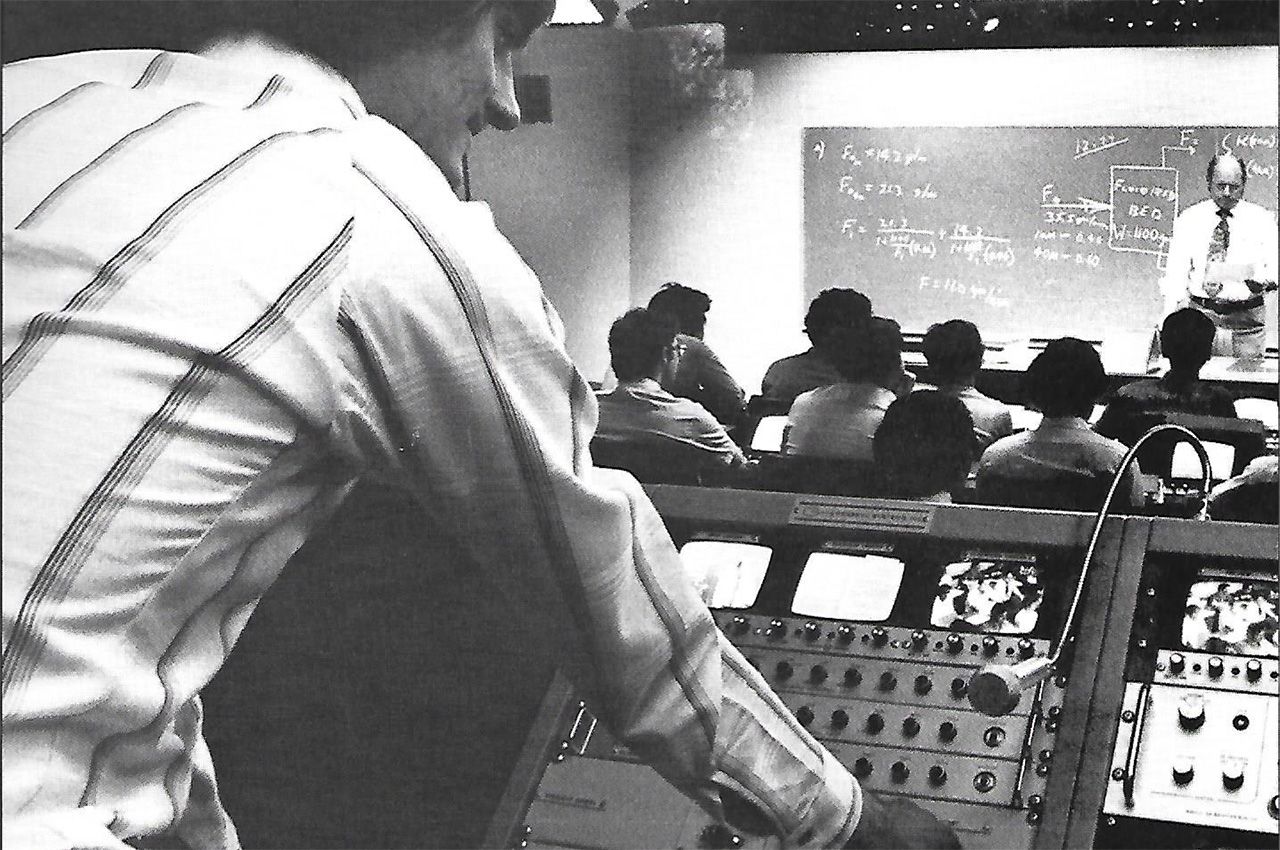
While America celebrates its semiquincentennial anniversary this year, Illinois Tech will recognize a technological milestone that set the university on its path to becoming a global education leader.
Fifty years ago, IIT/V—Illinois Tech’s live interactive education delivery system—premiered as the university’s original distance learning network, bringing courses to Illinois college students and corporate executives from as far north as north suburban Waukegan, Illinois, and as far south as south suburban Orland Park, Illinois, and laid the groundwork for Illinois Tech’s future distance learning expansion into Mumbai, India.
“What makes the birth of IIT/V so significant is that it transformed the concept of higher education delivery. Rather than requiring students to come to the university, Illinois Tech brought the university to the students,” says John Kazibut, the third chief IIT/V engineer and now director of Academic Technology Services for Illinois Tech. “That was a revolutionary idea at the time and laid the foundation for what would eventually become modern distance learning. In many ways, IIT/V was the first step in Illinois Tech’s evolution into a truly global university.”
Sent via satellite dishes and microwave antennas atop Illinois Tech’s Stuart Building at 31st and State streets to powerful broadcast transmitters atop Sears Tower (now Willis Tower) in Chicago’s Loop, the invisible yet revolutionary signals “delivered 50 of IIT’s regular undergraduate and graduate courses to 225 students at seven receiving sites” after its first year of operation in 1977, as noted in IIT/V’s “The IIT Connection” newsletter.
Kazibut notes that two live channels were run during that first year, with two classrooms outfitted with Panasonic black-and-white tube cameras, monitors, and studio lights. Instructors wore lavalier microphones and students used push-to-talk mics, while remote students called in directly using standard telephone landlines.
“The system expanded rapidly,” says Kazibut. “Two additional channels were added in 1978, two more in 1979, and two more in 1980, ultimately bringing the total to eight channels.”
IIT/V began as part of the Federal Communications Commission-licensed Instructional Television Fixed Service spectrum, which was dedicated to one-way educational television. Each channel was six megahertz wide, and Illinois Tech’s eventual expansion into eight channels increased the number of learners across the region. Employees at “receive sites,” such as Motorola, Illinois Bell Telephone Company, and North Central College, could tune in for courses via a 2-foot-to-6-foot microwave dish that captured the originating signal.
“By establishing corporate partnerships as learning hubs, professionals in Chicago’s booming industrial, technological, and corporate sectors didn’t have to leave their employers to advance their education. This model fostered a mutual alignment with industry needs through continuous feedback loops between university faculty and industry leaders,” explains Norma I. Scagnoli, Illinois Tech’s chief learning and innovation officer and head of its Center for Learning Innovation. “Employers gained a direct mechanism to upskill their workforce in highly technical areas, while the university solidified its reputation as an industry-aligned institution dedicated to serving the community."
The most noticeable changes in IIT/V, however, occurred in the mid-1990s to the early 2000s, as the United States began its transition from the analog to the digital era. The ITFS spectrum name was rebranded as the Educational Broadband Service. Through digital compression technologies, IIT/V was able to transmit up to 16 instructional streams within the same bandwidth, thereby providing opportunities for an increased number of classrooms and receive sites. Illinois Tech also began its rise in global education by shipping VHS-tape lessons to engineers in Bangalore, India, allowing them to earn credits in fields such as communications technology.
But as high-speed internet access became increasingly available around the country, IIT/V adapted its distance-learning model to offer flexible, asynchronous course delivery through a newly formed IIT Online digital system. On June 12, 2009, full-power TV stations ended their analog broadcasts, per an FCC mandate. And at Illinois Tech, the 2012 fall semester marked the end of IIT/V.
Scagnoli acknowledges that several key factors drove IIT/V’s lasting impact on student and institutional receptiveness to distance learning.
“What began 50 years ago as microwave and television broadcasts has evolved into a global footprint,” says Scagnoli. “The fundamental lesson of IIT/V is that distance education succeeds not when it simply distributes content, but when it uses the technology of the era to cultivate meaningful human connection and accessible learning communities.”
Now, Scagnoli highlights the global distance learning innovations currently underway at the university: scaling performance-based admission for nontraditional learners through sequential pathway courses; designing credit-bearing professional pathways by mapping professional certificates into academic credit; establishing a hybrid global footprint such as the Illinois Tech Mumbai campus that is opening in fall 2026; and growing into a new student success architecture by expanding into proactive digital advising.
In his role as director of Academic Technology Services, Kazibut and his technical team partner with the Center for Learning Innovation to ensure that the university’s distance-learning technology continues on its upward trajectory.
“Modern students can access content on demand, participate from virtually anywhere, and collaborate beyond campus boundaries, while today’s digital technologies have expanded that reach worldwide,” he says. “While the technology has changed dramatically, the mission remains the same: using technology to connect learners with educational opportunities regardless of location.”
Now working in his 37th year at Illinois Tech since his arrival as an IIT/V engineer, Kazibut shares a story that assured him of the success of the university’s “bold experiment in educational television.”
“A memory that has always stayed with me came from alumni who would return to campus years later for events,” he recalls. “Occasionally, while our team was setting up cameras, an alumnus would recognize the IIT/V equipment and stop to tell us that they might never have earned their Illinois Tech degree if it had not been for IIT/V. Being able to attend courses at a corporate or public viewing site saved them from commuting through Chicago traffic and allowed them to balance work, family, and education.
“Hearing those stories reminded us that the technology we worked so hard to maintain was making a real difference in people’s lives.”