Designing and Building in Brazil’s Atlantic Forest Region
A dozen Illinois Institute of Technology School of Architecture students traveled to a rural Brazilian village to put their designs to a real-world test.
The students, part of Associate Professor Frank Flury’s Design/Build program, were charged with creating a small structure in an international locale.
They landed on creating a multipurpose pavilion—an open-ended space designed for large public gatherings—in Tijuca, a rural village made up of a couple hundred cattle and coffee farmers about two hours north of São Paulo, Brazil.
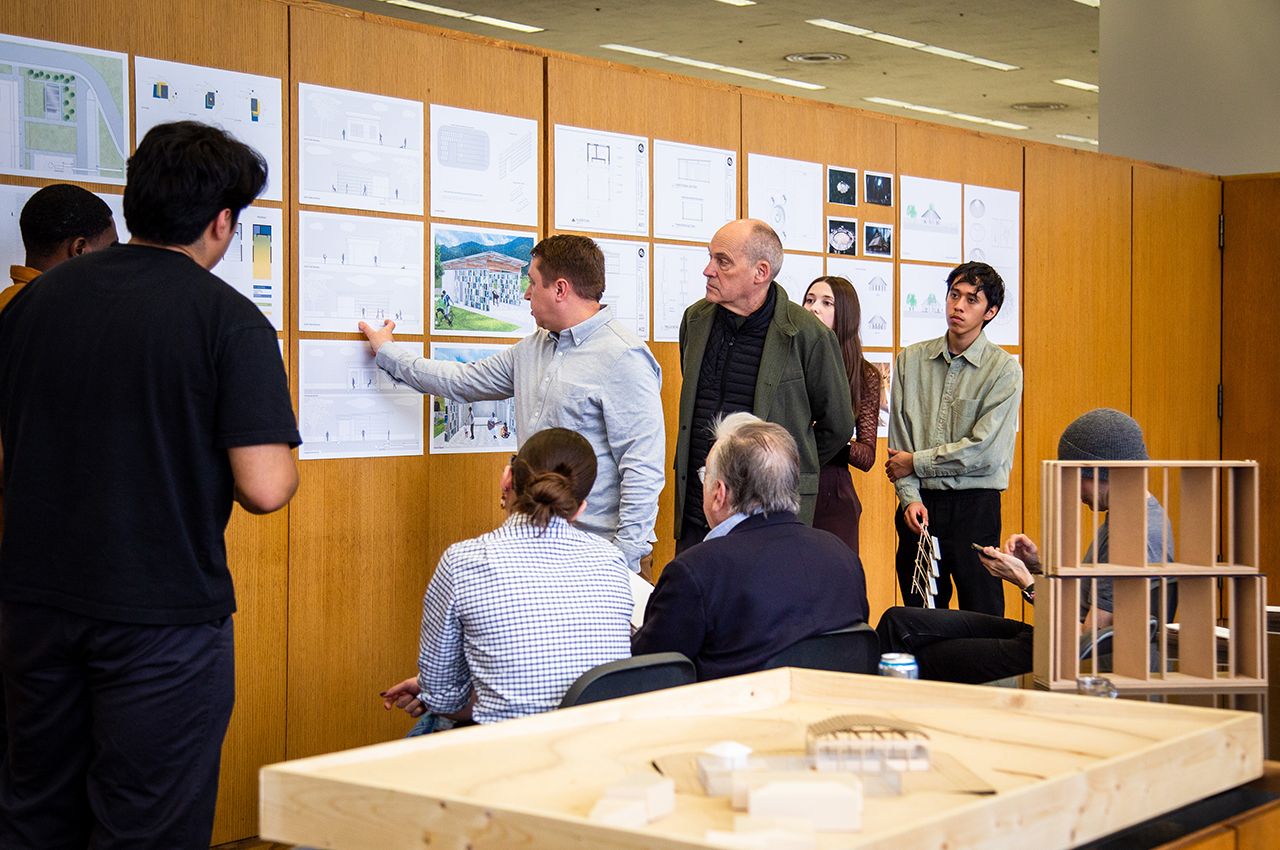
Before students left for the trip in the summer of 2026, they researched the area, its geography, and its culture, and created several designs which were judged by working architects and alumni.
“They’re going to be accountable to go out there and execute. What you put on paper matters,” Kevin Kamien (M.ARCH. ’10), a principal at Chicago-based Topohunto, said while judging the students before they left. “They’ll have to walk a line of keeping it within reason. A good thing about what Frank’s done here is he anchors it in a good site.”
One of the alumni judges had a personal stake: the family of Maria Alcantara (B.ARCH. ’26), who took Flury’s course when she was a School of Architecture student, owns PETTRUS Mineracao, natural stone company in the Brazilian port city of Cachoeiro de Itapemirim. Pettrus partnered with the Design/Build program by providing stone materials, accommodations, logistical assistance, technical expertise, and construction support for the 2026 project.
Alcantara also accompanied the students on the trip, helping them with accommodations and serving as a community liaison.
“I always saw [Flury] bringing kids to foreign countries and watching what they came up with,” says Alcantara, who approached Flury about helping. Flury chose and screened the location.
Before leaving for Brazil, students said they were excited to be able to test themselves in a real-world environment.
“I felt like I was missing the hands-on stuff,” Jason Orr (B.ARCH. ’26) said during the spring 2026 semester before going to Brazil. “Design work is cool, but if you have the experience of putting it together, it can only elevate you as a designer.”
Emma Balogh (B.ARCH. 4th Year) added in the spring, “I have been to construction sites, I tend to work better with hands-on materials, but I’d never worked actually building a building myself.”
During their 10 weeks in Brazil, the students quickly learned to adapt in the field and become on-the-spot troubleshooters.
Realizing they’d underestimated the impact of the region’s massive amounts of rainfall, the students increased the width of the building’s gutter, doubled the number of downspouts, and raised its foundation. They also changed the base dimensions from six by 18 meters to nine by 12, to better fit into the site’s geography.
“We also learned interpersonal elements,” Simon Nagi (B.ARCH. 4th Year) says. “The role of the architect is the role of a communicator, working with all the suppliers, construction workers, the community....There were a lot of interests, and so many people were involved in so many ways. I’m glad I learned that early in my career.”
Before the students returned to Chicago in August 2026, the local community organized a farewell celebration in the newly completed pavilion. The event included a Brazilian martial arts performance, in which three of the students participated.
“I think, in essence, we are doing a cultural exchange. Students go to a country and get very familiar with the community, get embedded. We are visitors but not regular tourists; we become part of the community,” Flury says. “They really grew up and took ownership of the building—they were very disciplined and organized. After two months they really worked well together as a team.”
Nagi notes that upon returning to the United States, the students “feel a lot more confident, both in themselves and their ability to make things. We built a giant building, just 12 students, and it will be something that sticks with us for the rest of our lives.”
Photo: Associate Professor Frank Flury, center in black shirt, helps students of his Design/Build studio present their ideas for a Brazil project to alumni judges.