

Brains and Opportunity
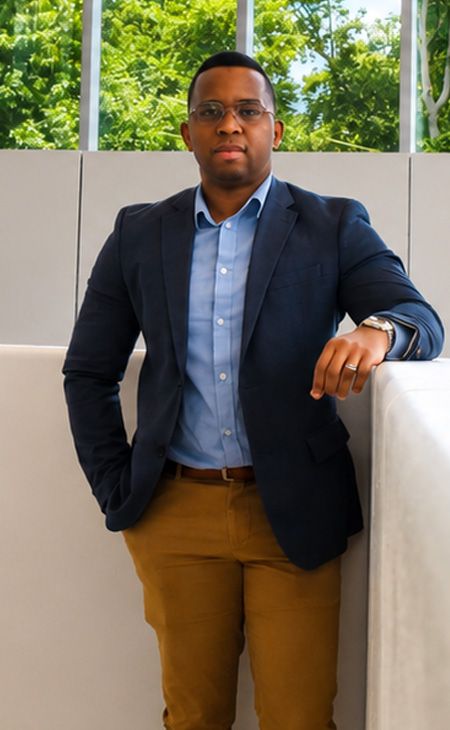
Licensing Associate, University of Pittsburgh Innovation Institute
Following his grandmother’s diagnosis with a brain tumor, Andy Daniel (BME ’13) focused on researching how a condition such as hers could affect brain function. His contributions to the field have led to an impressive number of publications and accolades.
Andy Daniel BME ’13Following his grandmother’s diagnosis with a brain tumor in 2016, Andy Daniel (BME ’13) focused on researching how such a condition could affect brain function.
“It became very personal to me. It felt like I was the right person at the right time to contribute to that science,” says Daniel, who grew up in a tight-knit family on the island country of St. Lucia.
Over the course of the next decade, Daniel trained across multiple labs and published numerous papers on brain tumors.
In 2021, Daniel joined the Hervey-Jumper Lab at the University of California, San Francisco (UCSF), where he was able to combine his background in biomedical engineering and neuroscience with cutting-edge technologies to study brain tumors from whole-brain networks down to the cellular level. While there, he was awarded a postdoctoral fellowship in translational medicine to further study how tumors interact with brain circuits.
“He was quite a gifted scientist. He won every award our field has to give,” says Shawn Hervey-Jumper, the UCSF neurosurgery professor who founded and still oversees the Hervey-Jumper Lab. “What intrigued me about Andy is he had a very clear focus on what he wanted to accomplish in life. That focus was biomedical innovation.”
In graduate school, Daniel used a technology called functional magnetic resonance imaging (fMRI) to examine how brain tumors change the normal functioning of the brain. This type of research allows neurosurgeons to improve surgical planning and to better predict patient outcomes post-surgery.
He used the technology to help develop a mapping platform of the brain in its resting state, a baseline that allows researchers to track the brain’s functions when it isn’t involved in a specific task.
“Patients often present with debilitating symptoms that limit their ability to be candidates for task-based mapping where they would have to follow instructions. Also, certain brain networks require more assessment than a simple test could provide,” Daniel says. “Resting-state fMRI allows the clinical team to get more information about the tumor’s impact on the brain than standard task-based approaches.”
Two patents Daniel co-invented during graduate school contributed to the development of a resting-state brain-mapping platform utilizing a software suite of machine-learning algorithms that received clearance from the United States Food and Drug Administration in 2025.
But fMRI technology only allows researchers to see resolutions down to a square millimeter. Daniel also wanted to understand how individual tumor cells interacted with neighboring brain cells.
Fortunately, the Hervey-Jumper Lab was uniquely suited to answer those questions. Using living brain tissue samples alongside technologies such as cell culture, electrophysiology, and spatial genomics, Daniel could examine the molecular, cellular, and electrical interactions between neurons and tumor cells. One striking finding by Daniel’s team that sparked much discussion in the new field of cancer neuroscience was how tumors don’t simply kill but rather co-opt the brain’s activity to help themselves survive.
A paper Daniel co-authored and published in Nature in 2023 exploring glioblastoma—the most common and aggressive form of brain cancer in adults—found that a tumor “isn’t simply invading the brain, it actively rewires and integrates into the normal circuitry of the brain. It actually uses those corrupted functions to enhance its survival and grow the tumor faster,” Daniel says.
The research also helped demonstrate a drug called gabapentin—an epilepsy drug that slows brain hyperactivity—could be repurposed to help treat the condition.
Daniel’s work in cancer neuroscience also earned national recognition. At the Cancer Neuroscience Symposium in 2024, Daniel received the Novocure Award for Best Overall Cancer Neuroscience Abstract. The paper he presented on tumors and brain function is currently under review.
**
As a child, Daniel never imagined he’d leave St. Lucia, a country where only 3 percent of the population has graduate degrees. Growing up, he received a toy microscope from his uncle and developed a passion for science.
“I really wanted to understand how ideas become important and useful and how that leads to changes in society,” Daniel says.
His father went from being a lawyer and a magistrate to eventually becoming president of the country’s senate and speaker of the house. Still, Daniel considered college out of reach. “It was for the wealthy. Wealth and politics are very different in St. Lucia relative to the U.S.; my father was a magistrate at the time, and it wasn’t highly paid. I assumed I’d have to work for years to save.”
But after winning a public speaking competition in secondary school, Daniel became a junior minister of tourism at the Caribbean Tourism Organization’s regional youth congress. It opened up a world he hadn’t imagined before.
“It really made the world feel bigger than I thought it was. I was from a small island and that exposure showed me that more was possible,” he says.
In his last year of community college in St. Lucia, Daniel says fate offered him another gift.
He met Carl Mack, the former executive director of the National Society of Black Engineers, who was visiting the country to encourage young students to strive for higher degrees. Mack helped him secure a partial scholarship to attend Illinois Tech.
After graduating, Daniel joined the Epilepsy Research Lab at Cornell University as a research assistant and later enrolled in Washington University in St. Louis, where he received his doctorate degree.
Daniel always kept in touch with his grandmother until she passed away from her tumor in 2024.
“I know she was very proud of me,” he says.
Her diagnosis ultimately shaped not only his scientific career, but also his broader vision for innovation.
“I ultimately want to help people build things that matter, especially those who historically haven’t had easy access to ecosystems, be they innovation or health care,” he says.
While at UCSF, Daniel took part in an internship at the Office of Technology Management, where he specialized in “technology transfer.” He evaluated different technologies coming out of the university’s labs that were primed for commercialization. In essence, helping get technologies that could alter or save lives to market faster.
He liked the experience enough to want to pursue it full-time. In early 2026, he took a job as a licensing associate at the University of Pittsburgh Innovation Institute, where he helps fast-track physical and life science technologies for commercialization.
While he’s new to the job, Daniel says it’s exhilarating.
“The throughline for my life has been trying out new opportunities as they present themselves. I’ve been lucky to have been in the right place at the right time, but also taking opportunities as they came,” he says.
Colleagues say it’s another positive step for Daniel on a path filled with them.
“We do need really good scientists who can work with companies and universities and smooth those processes,” says Hervey-Jumper. “Andy’s held to that: taking in innovation scientifically, but who also understand that process.”
“One thing I noticed about Andy is he was never looking for shortcuts. A lot of folks just take the shortest route to get where they’re going, but not him.”