

The Human Side of Business Laws
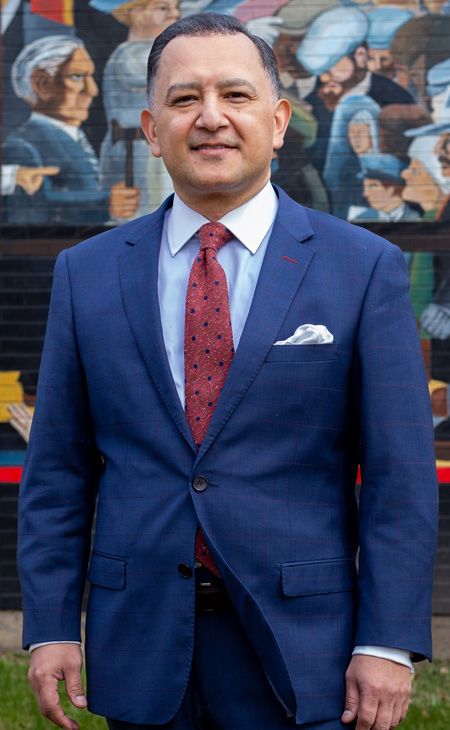
Shareholder, Greenberg Traurig, LLP
Daniel Canales ’08 knows that employees make a company, so he advises companies how to do right by their workers while also protecting themselves.
Daniel O. Canales LAW '08“Human capital is important, right?” says Daniel Canales ’08. “You are your employees.”
Canales is a shareholder at Greenberg Traurig, LLP, where he helps companies navigate a variety of business and legal issues, largely labor and employment related.
But in college he had very different aspirations.
“I went to Northwestern University for undergrad thinking that I wanted to be an art teacher,” he says.
But an internship in a corporate human resources department sparked a new interest, so he switched his major, graduated, and landed a job in HR consulting at Deloitte.
“I viewed that as sort of being a teacher for a company,” he says. “Then I realized that the law was butting up against everything I was doing.”
Four years into his professional career, he enrolled at Chicago-Kent College of Law, eventually earning the labor and employment law certificate.
“Every law school is going to have an employment law course and labor law course, but Chicago-Kent put it in a complete package,” Canales says, “and it wasn’t lost on me that there was a nice bit of theory, a nice bit of real skills involved, and practical internships through Chicago-Kent that all really paid dividends.”
He spent one summer at the Illinois Educational Labor Relations Board, a state agency that protects educational employees’ right to organize and bargain collectively.
However, because his education at Chicago-Kent exposed him to so many different sides of labor and employment law, and his experience in corporate HR and consulting, he knew that he wanted to represent employers.
“[Professor of Law Emeritus] Martin Malin and [Clinical Professor of Law Emeritus] Richard Gonzalez never took the position that relations between employers and employees had to be contentious,” says Canales. “They really provided [all] sides of the coin, so to speak: the employer, the employee, and the union.”
Now, Canales still takes that collaborative approach to his work.
“Even in the labor union environment, there’s a misconception that there’s always tension,” he says. “Sure, you have to bargain over a contract, but we’re trying to find solutions and work together to get it done. I don’t view that as necessarily contentious.”
After law school, he joined Ogletree Deakins, which focuses exclusively on labor and employment law, the only type of law that Canales wanted to practice at the time.
“Every workforce is different,” he says. “A unique aspect of employment law is that every company has employees, which means we service every single industry. Every industry provides something unique; a tech company out in Silicon Valley is going to have different issues than say, a manufacturer in Pittsburgh.”
While at Ogletree Deakins, Canales stayed in touch with law school friend Andy Hettinga ’08, vice president and associate counsel for labor and employment at Dover Corporation.
Since joining Dover 10 years ago, Hettinga has continued to retain Canales as counsel on a host of different matters.
“Dan’s an exceptional lawyer,” says Hettinga. “He’s aggressive, very intelligent, creative in his thinking, but, most importantly for me, he’s practical in the sense that he always has a focus, to some degree, on the reality of our business.”
Hettinga continues, “Dan has gotten his head around the idea that the super conservative, safest approach may not always work for every business. He tries to find a solution that makes sense—keeps you in compliance but makes sense.”
Canales spent 12 years at Ogletree Deakins, eventually becoming a shareholder.
During his time there, he saw how the relationship between employees and employers is shifting with the evolution of technology.
“We helped out some of the new gig economy employers,” says Canales. “That was at the forefront of challenging what it meant to be an employee versus an independent contractor.”
In 2019 Canales decided that he was ready for his next challenge, so he left Ogletree Deakins for Duane Morris, a general practice firm where he has worked for nearly seven years.
“I wanted to service my clients not just in labor and employment, but also corporate law, tax, [intellectual property], and all areas,” he says. “I needed a broader platform to serve my clients holistically.”
In 2023 Canales finally fulfilled his dream of being teacher when he began teaching an employment law course as an adjunct professor at Northwestern University’s Pritzker School of Law, where students are still talking about that gig economy work that Canales tackled 10 years ago.
“That’s a lively class: [we discuss] what it means to be an employee and what the new generation of employees is expecting from their employers,” he recalls. “It’s fun. It keeps me fresh, engaged, and challenges me.”
These days, Canales splits his time between labor and employment work and his multidisciplinary practice.
He’s even picked up some international clients, which is teaching him about labor laws and employee relations in other cultures.
“Other countries are probably more employee-friendly in some ways,” says Canales. “We may demand more of our employees here in the United States. But there are trade-offs, right?”