

Scouting’s Merit Badge Master
Cyber Operations Specialist, U.S. Air Force
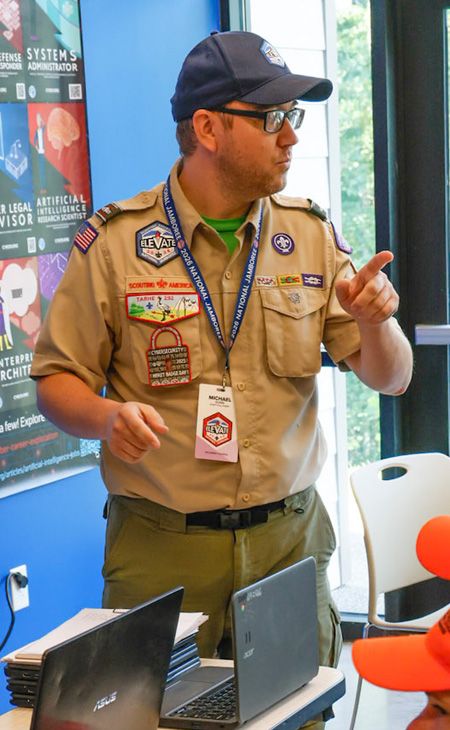
Lt. Col. Michael Dunn (CS, M.P.A. ’10) advanced through the ranks of the United States Air Force because of his proficiency in cybersecurity. But one of his hobbies was equally close to his heart: helping to create Scouting America’s new cybersecurity merit badge.
Michael Dunn CS, M.P.A. ’10When Scouting America rolled out a new merit badge for cybersecurity in late 2025, the organization tried hard to stick to its motto: “be prepared.”
But the rollout of one of the organization’s first new merit badges in years was a true test of preparedness, says Paul Yackinous, the Scouting America official who oversaw the team that created the badge.
“We’ve never seen anything like it,” says Yackinous, who is vice president of membership for Scouting America’s Silicon Valley Monterey Bay Counsel. “Usually with events, you’ll offer a lot of merit badges at once, 15–20 different ones, and you’ll be lucky to get 50 kids to them....[For cybersecurity], we had merit badge workshops that were really highly attended across the country. One local union hall had space for 150 kids, and it sold out in 10 minutes—we could’ve done three of them!”
Critical to the creation of the cybersecurity merit badge was Lt. Col. Michael Dunn (CS, M.P.A. ’10), who joined the scouts in the first grade and is now a cyber operations specialist for the United States Air Force.
As a member of the now discontinued Troop 562 in Woodridge, Illinois, where he grew up, “I really liked merit badges. It exposed me to careers and hobbies which I still do today,” Dunn says. His interest in genealogy, for example, can be tied to the genealogy merit badge that he received as a pre-teen. In cyber operations for the Air Force, he was in charge of protecting the communications networks that the Air Force relies on, as well as other assets.
“Modern aircraft are flying computers,” Dunn says.
Dunn rose in the ranks in the Air Force as someone who had a penchant for maintaining and defending the military’s computer networks, both stateside and overseas. He was stationed in Mississippi, Nevada, Texas, and Qatar during the Global War on Terrorism.
“Air Force networks are bombarded from cyberattacks by anyone from curious ‘script kiddies’ to nation states,” Dunn says. “There’s more and more things we can do in cyberspace, and more and more things we’re having to defend against.”
But when Dunn was getting his master’s degree in cyber operations in 2018 while stationed at Wright-Patterson Air Force Base in Dayton, Ohio, he wrote a thesis on extracurricular cybersecurity education. As a small side project of that, he proposed a cybersecurity merit badge.
Yackinous says that when it comes to creating a new merit badge, “None of this is written down. There are 138 of them, and there’s nothing like, ‘It takes five hours to do a merit badge.’ Theres nothing set up like that.”
At least, until Dunn came along. The meticulous Air Force officer surprised everyone by completing an in-depth analysis of the career-focused merit badges, particularly those related to STEM.
“He did data analysis, categorized them, ordered them by different requirements. He’s now literally the world expert on this topic,” Yackinous says.
Dunn, along with another Ohio merit badge counselor named Robert Caruso, helped push the cybersecurity badge idea at the national level.
“This was Mike’s idea from the beginning. It was due to tenacity; they kept poking and nagging,” laughs Yackinous.
It helped that Scouting America’s new chief scout executive, Roger Krone—the former CEO of Leidos, which develops and manufactures airport baggage screeners—was very vocal about wanting the scouts to offer new STEM-based badges.
The tricky part was taking a concept such as cybersecurity and making it digestible for an 11-year-old. Dunn’s initial proposal was used as a starting point.
In the end, the badge focuses on teaching scouts about safety and ethics, as well as fundamental cybersecurity concepts and threats.
“What is malware? What are risks of using unsecured Wi-Fi?” Dunn says, explaining the basics of the badge curriculum. “The badge is hands-on: checking to see if a system is outdated; creating strong passwords; learning multi-factor authentication; seeing what’s running on a computer; learning how to backup data and do virus scans; learning cryptography and encryption; and also learning about careers in cybersecurity.”
The badge was launched in October 2025, along with an artificial intelligence merit badge that Dunn was not involved in. In the first 11 weeks, it was earned 952 times, making it one of the most popular badges in scouting history, Yackinous says.
For his part, Dunn held a cybersecurity merit badge day at Wright Patterson Air Force Base, hosting 300 scouts with the help of 80 volunteers from the Ohio Cyber Reserve.
“I still get comments from people that came out of that,” says Dunn, who was also invited to put on a cybersecurity program at Scouting America’s primary national jamboree, at the Summit Bechtel Reserve in West Virginia in July 2026.
“It’s getting easier and easier to sell the importance of cybersecurity,” Dunn says. “You can’t go two days without seeing an article about a cyberattack....On a more personal note, everybody in their home, school, and work are constantly online, always connected. There’s a lot of opportunity to both defend ourselves and project power through cyberspace.”