CyberHawks Crack Code in Pen Testing Competition, Building Professional Skills
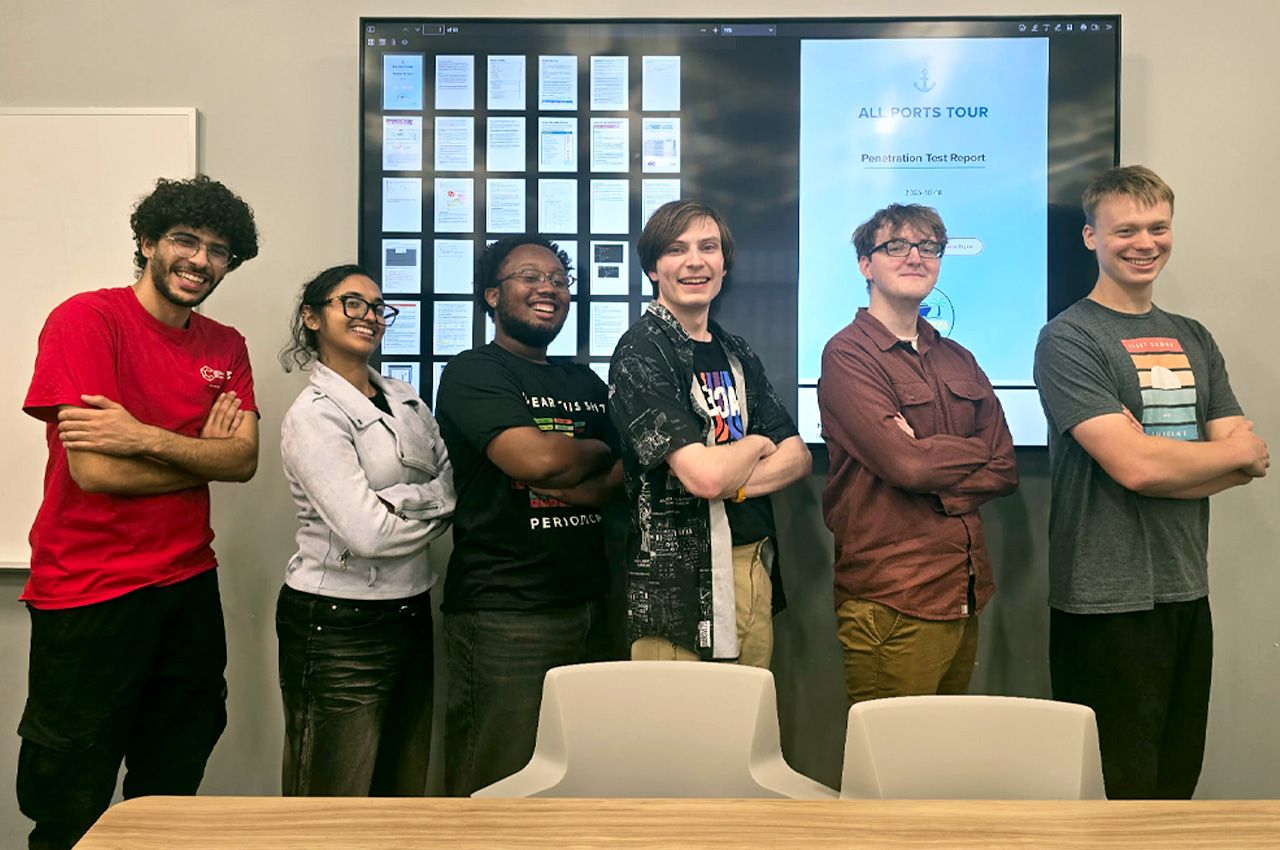
Representatives from Illinois Tech’s CyberHawks cybersecurity student organization complemented their technical skills with professional soft skills as they claimed third place at the Great Lakes Regional of the Global Collegiate Penetration Testing Competition (CPTC).
Cybersecurity teams from 10 universities convened at Baldwin Wallace University in Berea, Ohio, to compete in a real-world penetration testing contest. The competition mimics activities performed during a real-world penetration testing engagement conducted by companies, professional services firms, and internal security departments.
“The competition showed us that cybersecurity is a mix of technical skill, teamwork, problem solving, and responsibility,” says Mohamed Trigui (CS, M.A.S. CYF 5th Year), CyberHawks team captain. “The biggest value was the exposure to real offensive security work and what a day looks like for an ethical hacker. The main lesson we took away is that security is not only about finding vulnerabilities. It is also about thinking like an attacker, understanding how small weaknesses connect, communicating clearly with clients, and working under pressure while staying organized.”
The competition establishes a mock organization that is soliciting penetration testing services. Students act as members of a security firm and are asked to not only perform the testing, but also provide deliverables such as presentations to the mock client and recommendations on their discovered vulnerabilities.
“On the professional side, CPTC taught us how important communication is,” Trigui says. “Writing clear findings, explaining risk to a client, and working as a team are skills that matter even more than the technical part. It also showed us what real penetration testing looks like, which gave us a clearer sense of the standards and work ethic expected in the industry.”
Trigui was joined by Benjamin De Pater (CS 4th Year), Lucas Ferguson (CS 4th Year), Natorion Johnson (ECE 3rd Year), Kacper Stasik (CS 4th Year), and Mohithaa Ekambaram (M.A.S. CYF 2nd Year). The team was coached by alum John Ford (ECE, M.S. ECE ’23), who currently works as a penetration tester at NetSPI, and were accompanied by Illinois Tech Industry Professor of Information Technology and Management James Papademas. Jeremy Hajek, industry professor of information technology and management, gave the team access to the cyber range in the university’s Smart Tech Lab.
“John did not just share something impactful. He is the main reason we performed the way we did,” Trigrui says. “He came with us every Saturday to the Smart Tech Lab and taught us advanced penetration testing skills from noon to six for weeks. He set up our entire lab environment. He introduced us to our reporting tool. He guided us like someone who genuinely wanted to see us grow and succeed.”
Trigrui says access to the university’s cyber range provided the technical support that they needed to hone the team’s skills for the competition.
“It would have been very challenging to prepare without the cyber range,” he says. “Having access to a real lab environment made a huge difference in how we practiced and how well we understood the technical parts of the competition.”
Image: Members of Illinois Tech’s CyberHawks, a cybersecurity student organization, at Baldwin Wallace University in Berea, Ohio where they expanded their skills in the Global Collegiate Penetration Testing Competition.