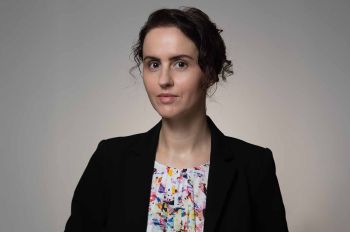
Defining Design: Chicago-Kent Professor Cited in Federal Judicial Ruling

“I’m gratified and honored when a judge finds my work to be helpful—especially where, as here, they’re dealing with new and novel legal questions,” says Chicago-Kent College of Law Professor Sarah Fackrell.
In March 2026 Fackrell’s paper, “Uncreative Designs,” which was published in Duke Law Review in 2024, was cited by United States District Court for the Southern District of New York Judge Jennifer L. Rochon in the Shunock v. Apple, Inc. case.
Entrepreneur Michael Shunock has alleged that Apple’s “Activity Ring” icons that appear on Apple watch screens to track walking, standing, and sitting time were infringing on the design of his company’s graphic user interface, which had a similar design.
Fackrell’s paper directly discusses the patentability of those interfaces.
“To prevail on a claim of infringement, a copyright owner must prove that the defendant copied ‘constituent elements of the work that are original,’” Fackrell writes. “Copying ideas is not enough, though line-by-line duplication is not required.”
Fackrell, who also acts as co-director of Chicago-Kent’s Intellectual Property Program, says that the courts have been struggling to define “obviousness” in patents, which determines which patents are valid, since the LKQ Corp. v. GM Global Technology Operations LLC decision in 2024.
“That decision left a lot of issues, including the exact scope of the prior art, up to further development by the district courts,” she says. “In the Schunock v. Apple case, the judge is dealing with one of those issues—namely, what is the proper scope of the prior art?”
Rochon, using Fackrell’s paper, found that Apple had not infringed on Schunock’s design, as the two were not similar enough to constitute infringement.
“The Court finds that no reasonable jury could find that Defendant has infringed any of the Asserted Patents, because the Activity Rings are plainly dissimilar,” Rochon writes.
Fackrell’s work has been cited by judges before.
In August 2025, her paper, “The Counterfeit Sham,” was cited by Judge John F. Kness in the United States District Court for the Northern District of Illinois.