

An Astronaut’s Best Friend
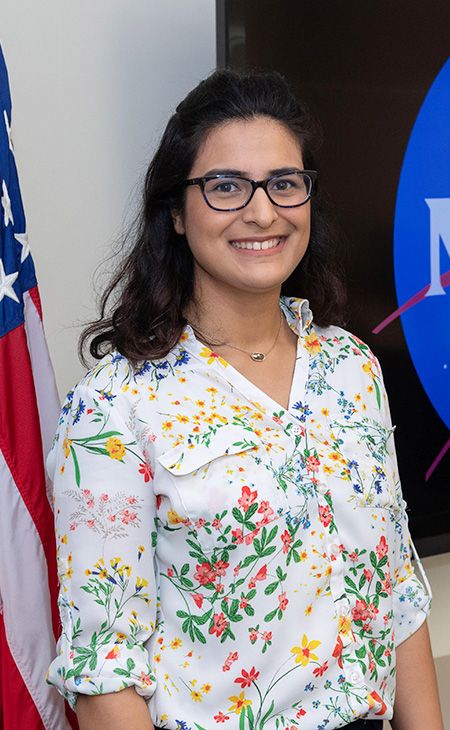
Technical Assistant, NASA’s Johnson Space Center
Sofia Ghouse (AE ’12) started by talking astronauts in orbit through their technical problems. Now she’s the Johnson Space Center director’s top technical assistant.
Sofia Ghouse (AE ’12)Sofia Ghouse (AE ’12) had to fix a toilet, and fast.
The problem wasn’t that simple, though: the toilet was 250 miles above Earth, aboard the International Space Station, and was the sole commode for six astronauts.
As an operation support officer, Ghouse manned a massive console at NASA’s Johnson Space Center and needed every inch of it to research maintenance options and communicate them to tired astronauts nearing the end of their shifts.
“Every day of a new shift, you don’t know what sort of problems you’re going to get,” Ghouse says. “There are days on the console where you may have less activity and the day is a bit more quiet, and all of a sudden something may require immediate attention.”
After pouring over the toilet’s specs, Ghouse was able to identify a new pump configuration that required replacing its cap, and soon everything was flowing smoothly again.
“Working through conflict at the end of the day is a stressful time. Astronauts’ 12-hour workdays are dynamic, so the last thing you want to do is put them in discomfort as they’re going into the evening. The skills of thinking critically, problem solving, communicating effectively, and giving correct instruction are a non-trivial act,” Ghouse says.
Over the years, Ghouse has learned to excel at those non-trivial acts, advancing from nearly three years of training to become a “backroom controller,” managing mission tasks such as in-flight maintenance and inventory control. She trained another two years to be certified to tackle higher-priority tasks in the center’s flight control room and then become a training group lead for “intra-vehicular activity,” meaning any activity of astronauts aboard a spacecraft.
In May 2025, Ghouse’s expertise was recognized when she accepted a detail as technical assistant for NASA’s Johnson Space Center Deputy Director Steve Koerner.
“Sofia has been an incredible asset to NASA. Her contributions to human spaceflight go beyond her technical expertise. She is a true leader, a collaborative team member, and someone who consistently drives mission success,” says Koerner. “Her ability to guide, support, and champion those around her has been instrumental to the Center Director’s Office.”
Ghouse has overseen the certification of numerous flight controllers and instructors, and was recognized in a recent NASA statement for “her efforts in mentoring, strategic planning, and innovation leadership.”
During her detail assignment, which focuses on administrative leadership, “It’s a real inflection point in my career, how the agency works and how the center works to better support my teams in the future,” Ghouse says. “The thing I enjoy the most about being a team lead is being able to measure, mentor, and develop others, and cultivating a healthy culture of a team.”
Growing up in northeast Ohio as the daughter of Pakistani immigrants, Ghouse bought a telescope at the age of 12 and sought out quiet areas to stargaze while her father worked evening shifts. She won her middle school’s bottle rocket competition, shooting a firework farther than anyone else in her class.
“Intuition and testing,” Ghouse says when asked how she won.
Before coming to NASA, Ghouse was at a renewable energy startup working on a technology that converted kinetic energy into electrical energy in third-world countries.
“There was an energy of possibilities, that whatever you build and contribute is directly impacting the success of the organization,” she says. She also had to wear multiple hats, garnering business acumen and the desire to pitch on tasks she wasn’t trained for.
It was that culture of time-sensitive adaptability and flexibility, Ghouse says, that gave her a leg up at her next job.
In 2014 Ghouse saw a posting for a NASA contractor to work at its Johnson Space Center in Houston—the main source of support for those sent to the International Space Station, among other missions.
The posting was for an operations support officer who would be responsible for assisting astronauts across a wide range of support functions. These included basic habitability, ensuring astronauts could comfortably eat, sleep, and drink while on station, as well as maintenance tasks to keep the more than 25-year-old station running efficiently. She also supported station docking and supply transfers, and even assisted astronauts with their astrophotography.
If that sounds like a lot to train for, it is.
The old astronaut axiom, “plan, train, and fly,” applies to flight controllers as well, Ghouse says. The roughly two years that astronauts spend training and practicing for each individual mission are often spent in conjunction with flight controllers, who must understand missions fully themselves to troubleshoot in times of potential crisis.
When asked what people who only knew about flight controllers from Hollywood movies might not know about their job, Ghouse says, “The planning and prep that goes into a mission. Mission control is just the tip of the spear.”
“If you’re watching a football game, you say, ‘That’s what you do.’ But it’s not all of what you do: there’s years of team building and practicing. It’s the same thing in mission control,” she says.
Ghouse currently serves as the Intravehicular Operations Exploration Group lead, where she supports vehicle development, crew and flight controller training, and mission operations for the Artemis campaign. Ghouse is also a member of the planning team for the Artemis II mission, a 10-day journey around the Moon designed to test the systems and hardware required to establish a sustained human presence on the lunar surface.
“Now, as a leader, exploring the different realms I can dabble in helps fuel my curiosity,” Ghouse says. —Tad Vezner