

Creating Harmony with Cuisine
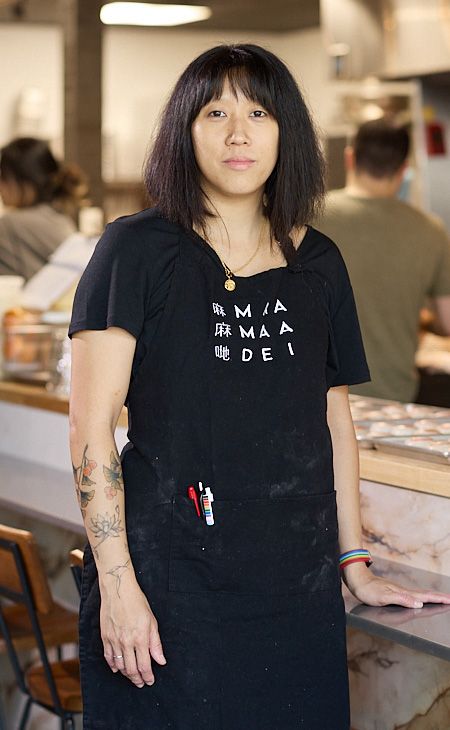
Founder, Maa Maa Dei
Growing up, Jessica “Jaye” Fong wasn’t allowed in the kitchen of her family restaurant. With the help of her mom, her Chicago pop-up restaurant is now winning awards and is the subject of a short documentary.
Jessica “Jaye” Fong (B.ARCH. ’12)Growing up working as a hostess at her family’s restaurant, Jessica “Jaye” Fong (B.ARCH. ’12) was never allowed in the kitchen.
“It was absolutely forbidden,” Fong says. “The children were not allowed in the kitchen; they would be underfoot, and there were sharp and dangerous things. I think my parents were concerned that we might actually show interest and passion and skill in the kitchen, and they actively did not want to foster that, because they knew how difficult of a life it was to run a restaurant.”
But when the COVID-19 pandemic hit, Fong—who had quit her job as a designer and been furloughed from her job at a hotel—spent her time during quarantine “cooking and baking the things I was missing.”
“I researched and baked things I wished I knew how to do and wanted to eat myself. The things I was never taught—all of the Chinese bakery items, specifically, because we weren’t able to get those,” Fong says. “It’s one of those situations where you’d have to go to an auntie or grandma, and not a lot are passing on that knowledge.”
Following the death of George Floyd, Fong put on a socially distanced Black Lives Matter fundraiser via her Instagram in which she sold her desserts and donated the proceeds to a local nonprofit, Black Girls Break Bread. In doing so, she connected with another pair of pop-up entrepreneurs, and she was surprised to get a call from one of them later that week.
The pop-up entrepreneur didn’t serve desserts. They asked: would Fong let them sell some of hers?
“I didn’t expect to have such a positive response from people, that they liked what I made. Like a lot of pop-ups, it was very underground to start,” Fong says. Large-scale events were forbidden during the pandemic, and chefs were searching for new sources of income.
After a few more events and building more connections within the pandemic-born pop-up community, Fong launched her pop-up, called Maa Maa Dei. It soon thrived, winning Best Pop-Up/Virtual Restaurant in the Chicago Tribune’s 2022 Readers’ Choice Food Awards.
Fong focuses on desserts that bring forth feelings of unity and family, often centering on holidays such as the Lunar New Year and China’s Dragon Boat Festival. Crowd favorites include her salted egg yolk shortbread cookies, Taiwanese pineapple cake, and rainbow taro mooncakes.
“She has so much pride in what she does, and you see and you feel it and you taste it in her food,” says Cat Pham, another pop-up entrepreneur who found Fong on Instagram and reached out to include her in events. “I’ve had the honor of being able to watch Jaye work. I see her technical background shining through; she’s incredible at precision and does a lot of research and development. She takes notes during every single run she does, down to the precise gram of it.”
Pham adds, “It’s not like a cold technical science; it’s a science of love and warmth and soul. Her food is beautiful, and her story is beautiful.”
But there is tragedy in Fong’s story as well, going back to her time at Illinois Tech.
After emigrating from Hong Kong and working for decades as the owner and head chef of multiple strip-mall restaurants in Bloomington, Illinois, her father, Simon Fong, died of cancer in 2010. Fong’s family was already somewhat estranged, with most of her siblings having moved away. The death fractured them even more.
“It was really up to me to be the mediator,” Fong says.
Fong rushed to complete her degree and moved back to Bloomington. The family’s restaurant at the time, Orient Gourmet, closed down following her father’s death.
Fong and her mother also suffered from a strained relationship. Her parents had always worked “24-7.”
“If you wanted to have any time with them, it was at the restaurant,” Fong says.
She tried to patch things up between her family members as best she could, then took an internship where she needed to commute to Chicago. She later took a job at Sargent & Lundy as a designer but quit after two years, realizing architecture was just not for her.
“It was terrifying, but I knew in my heart that when you’re raised in hospitality and your restaurant is basically a third parent, it’s very hard not to have it in your blood. I needed to be in that,” Fong says.
But when she started her pop-up, Fong says, something strange happened. Her mother began making frequent trips to the city to help.
“I didn’t really ask her to help; I think she just decided to be a part of it. And it was such a positive force that I was surprised at how well we worked together,” Fong says. “I do honestly believe the grief we went through with my father helped heal the relationship.”
In early 2025, Three Top Productions released a documentary film on Fong, titled What I Am Today: Maa Maa Dei.
At one moment in the documentary, taking a break in the kitchen, Fong says, “Part of this journey is about me teaching myself a lot of the things I wish I would’ve been taught. A lot of things that I do now come from a place of longing. I wish that there were things that [my father] would’ve been able to taste or try that I currently make. I hope that there are things that I make that he would’ve enjoyed.”
The message seems to have struck a chord with others in the Asian pop-up community, Pham and Fong say.
“One person came up to me and said, ‘This story gives other people hope, other children of immigrants hope that they, too, can find healing in their relationship with their parents,’” says Fong.
Adds Pham, “Jaye’s food tells so many generations of stories. It’s all in this beautiful piece of art that I get to eat.” —Tad Vezner