

A Different Build in Chicago
Learning by Doing
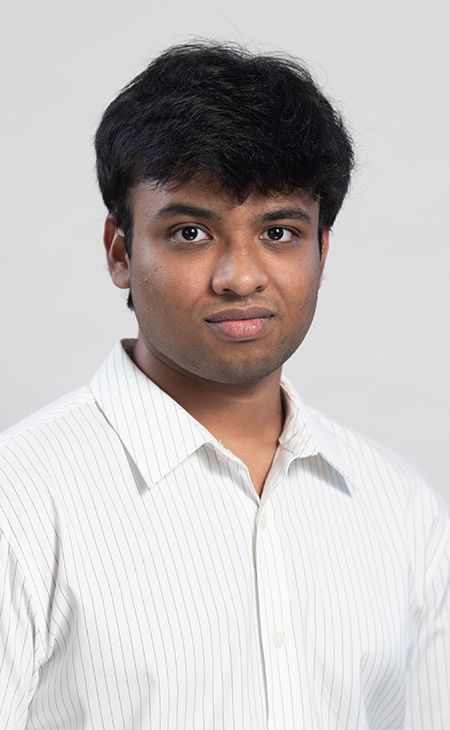
Working with people from diverse backgrounds and solving their specific needs has taught Lalith Kothuru the variety of ways that his computer science skills can be applied.
Lalith Kothuru (CS/M.A.S. 4th Year)The internships, research projects, and campus leadership roles that Lalith Kothuru (CS/M.A.S. 4th Year) found at Illinois Tech pushed him to apply concepts that he learned in the classroom while earning computer science degrees.
“The culture is very, ‘What are you working on?’” he says. “It naturally trains you to think like an engineer and a problem-solver. Illinois Tech feels different because it’s built around building.”
Whether conducting research or building tools for campus offices, Lalith says that the university provides the resources and platforms to turn a technical idea into a functional reality.
His experience has been varied in not only the kinds of work that he has conducted but the different fields that he has been able to apply his skills. He worked as a full-stack developer as an intern at M1 Finance in Chicago, where he developed financial management software. He worked as a research assistant for Illinois Tech Assistant Professor of Biomedical Engineering Keigo Kawaji, where he developed U-Net-based image segmentation models for medical diagnostics. While competing in the Grainger Computing Innovation Prize, he worked on a team that developed Ocean’s Four vAr-I, an artificial intelligence-fueled app that is used to forecast plastic drift in oceans, which earned a $5,000 cash prize. His Interprofessional Projects (IPRO) Program experience found him analyzing 400,000 Chicago water lines for lead contamination risks.
His work has even stretched to assisting Illinois Tech’s Office of Undergraduate Admissions.
“My friend who works as a Hawk Ambassador reached out to me, and I helped them build custom products such as a digital queue system and an event timer to streamline their operations,” he says. “I am currently developing technical solutions for Illinois Tech’s Discover Day and Leadership Symposium events coming up.”
His rigorous and specialized academic preparation has helped him become adaptable and able to tackle an array of challenges, as Lalith explores specializations as part of his academic experience in database systems, data analytics, and cloud computing along with a minor in data science.
“The strength of this program lies in its flexibility,” he says. “I can dive deep into low-level systems programming while simultaneously mastering high-level machine learning and data science concepts.”
Studying in Chicago has also been beneficial, helping him make connections and find opportunities. He describes the city as an extension of Illinois Tech’s campus as it has allowed him to intern at a major fintech firm such as M1 Finance or engage with local data to solve real-world problems.
“Illinois Tech being in Chicago, a global hub for finance and tech, offered the perfect backdrop for internships and professional networking,” he says. “Being in Chicago also makes it easier to connect what you’re learning to real internships, events, and industry problems.”
As a result, Lalith says it isn’t uncommon to see groups posted up in labs and study spots, collaborating on projects, swapping ideas, helping debug, and pushing each other forward.
“What makes it fun is that the social life grows naturally out of that shared momentum,” he says. “You meet your people through courses, clubs, hackathons, and project teams, and suddenly late-night work sessions turn into food runs, inside jokes, and ‘we actually pulled it off’ moments after a demo finally works. It feels like a place where you don’t just attend school, but you become part of a community of builders.”