

Material Gains
Co-Founder, Mattiq
The company that Andrey Ivankin co-founded helps businesses identify the perfect chemical compound for whatever they might need.
Andrey Ivankin (Ph.D. CHE ’10)If you try to list all the potential combinations of all the elements on the periodic table, you’ll have a list that’s practically infinite. To date, humanity has only characterized about a million of them.
“What is the chance that every process out there is using the optimal material?” asks Andrey Ivankin (Ph.D. CHE ’10). “If you ask me, very little.”
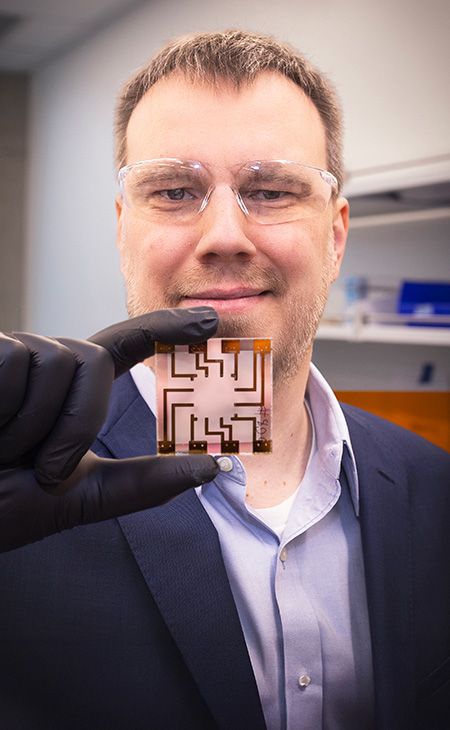
That’s where the potential of Mattiq—the company Ivankin co-founded in 2020 with Northwestern University Professor Chad Mirkin—comes in. The two chemists have developed a highly technical machine that fabricates millions of tiny nanoparticles—elemental compounds as small as a billionth of a meter in length—all at once atop a tiny two-square-inch plate. Then, with the assistance of machine learning, the machine tests their properties and uses that data to predict the properties of billions more.
Ivankin hopes to record all those properties and build a database that scientists and industry leaders could use to choose the perfect compound for their nascent technologies. Mattiq has already garnered commercial interest: Germany-based Heraeus Precious Metals used its technology to identify more effective catalysts for its industrial processes.
“If you have artificial intelligence working in the loop [as new materials are created] and learning about those individual materials’ properties, you don’t even have to synthesize and screen the new materials, because the AI learns about the physics of the [created] materials and uses it to predict new ones,” Ivankin says.
All materials have a plethora of properties that make them valuable—or not—for research or industrial use. Are they a good catalyst? For what? Are they stable? Do they reflect light? Do they lose utility at high temperatures? Are they magnetized? Easily corroded? To date, researchers have documented only about 300,000 of these “material properties.”
Ivankin says Mattiq’s technology could double that amount in just a couple of years.
“The data factory, once built, can produce experimental datasets faster than anyone else in the world,” Ivankin says, going on to explain that, “AI has transformed almost every aspect of our lives—but not materials discovery. That’s because AI needs reliable data to learn from, which is lacking in materials science. The data factory aims to solve for it.”
Adds Mirkin, who is also the founder and director of Northwestern’s International Institute for Nanotechnology, “Right now, everyone uses trial and error to test one material at a time. Now [at Mattiq] we can test millions at a time. We can synthesize literally millions of materials in a single afternoon—all different. And we can screen them and look at their prosperities en masse.
“Andrey was the technical mastermind who built this great capability.”
Currently, AI models such as Google’s DeepMind use simulations based on simplified quantum chemistry to predict qualities of theoretical materials. However, “We know those assumptions don’t work very well,” Ivankin says.
By actually creating those new materials and then using AI to measure their real properties, “there will be no assumptions, just empirical, ground truth,” Ivankin adds.
Companies could then figure out which materials they’d like to try in their industrial processes.
Ivankin notes that initial predictions, when catalyzing elements in the trial-and-error phase of chemistry, are only correct 5 percent of the time, so even if they got to 10 percent success, “you just doubled your productivity,” he says.
“The worst thing you can do is pick [a material for a product] at small scale and spend tens of millions to bring it to market, then find out if you’d just added 5 percent of another element it behaves two times better,” Ivankin adds.
The son of two scientists from Siberia, Russia, Ivankin received his bachelor’s degree in chemical physics from Novosibirsk State University before coming to Illinois Tech.
He spent some time researching how to improve antibiotics at Argonne National Laboratory before researching DNA sequencing at Northeastern University. In 2015 Mirkin hired Ivankin to join him at Northwestern University, and the two started their first business together.
“In addition to being a superb intellect, Andrey is an incredibly high-quality person. He leads by example and has an incredible work ethic,” says Mirkin. “We go after very aggressive goals and projects, and he’s someone who consistently over-delivers.”
The two—along with Mirkin’s son, Ben Mirkin—initially founded TERA-print, which manufactures universal nanoprinting tools that allow for advanced fabrication. While 3D printers have a level of precision of 25 micros (each 1/1000 of a millimeter), nanoprinters can achieve precision 250 times smaller, allowing for detailing and control of individual cells. The company’s TERA-Fab series tools are now used in eight countries.
When the COVID-19 pandemic hit in 2020, Ivankin says, the two had the time to look for a new challenge that built on the tools developed by TERA-print—so they founded Mattiq.
Ivankin believes Mattiq “fits with the times” when many critical manufacturing materials, such as rare earth elements, are often produced in countries that may not have positive relationships with the United States.
“One idea is to secure supply chains from elsewhere. The other is to identify other compounds that behave similarly. We can help with the latter,” Ivankin says.
And the cumulative database of compounds will make each search a bit easier for those in industry.
“Once you have that, you have the gift that keeps on giving,” Mirkin says. —Tad Vezner