

The Music of Justice
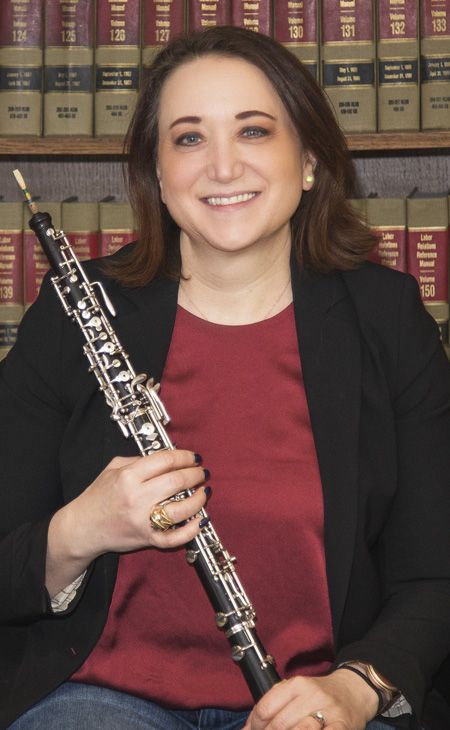
Shareholder, Asher, Gittler and D'Alba, Ltd.
After a career in classical music turned into a labor negotiation, Naomi Frisch ’18 turned her day job into her night job—and now represents the musicians with whom she plays.
Naomi Frisch LAW '18Naomi Frisch ’18 was a young musician, working her first real job as a concert oboist in an orchestra, when her conductor was told to cut costs.
“He decided to fire the four oldest people in the back of the violin section,” she says.
The orchestra voted to unionize, and they’ve been enjoying worker protections ever since. That was when Frisch began to explore the benefits of collective bargaining.
“The idea that employees are free to contract and to demand a good wage for their services is really a fallacy,” says Frisch. “The only way that they can do that is by banding together.”
“Unions provide power to workers that they wouldn’t otherwise have,” Frisch says. “Unions are solidarity. Unions are safety. Unions are family.”
Before attending Chicago-Kent College of Law, Frisch built a career as a professional oboe player.
“Like many young people who got a degree in the arts, I cobbled together a living as a young artist starting out,” says Frisch, who earned bachelor’s and master’s degrees in music. “But by 2012, I had a young child and my husband had a health scare, and I looked at my life and realized I didn’t want to be scraping together 20 different jobs for the next 30 years. It’s not sustainable.”
After 10 years of unionizing with various orchestras and collective bargaining on behalf of her colleagues, Frisch knew exactly what her next step was: going to law school in order to be able to collectively bargain contracts.
She enrolled at Chicago-Kent, earning her J.D. along with certificates in labor and employment law and alternative dispute resolution. During law school, she was a law clerk for two years at Asher, Gittler & D’Alba, Ltd., which was a formative experience in learning important union-side labor law skills .
After graduating in 2018, she spent a year at Noelle Brennan and Associates and two years at the CTM Legal Group before re-joining Asher, Gittler & D’Alba, Ltd., as an attorney this time, where she then became a shareholder in January 2026.
She represents employees and unions, including many that represent musicians but other professions as well, including police.
“It can be challenging sometimes being an advocate for police unions in today’s world because they can be misjudged,” she says. “But I feel privileged to be able to represent them because police officers have one of the hardest jobs. It can just be a very thankless situation, but we all deserve to be treated well at work.”
Although she’s made it far in the legal world, Frisch never forgets her roots.
She still plays oboe in the Illinois Philharmonic Orchestra and serves as legal counsel to the Chicago Federation of Musicians, AFM Local 10-208, where some of her favorite work is guiding its Fair Employment Practices Committee. She also serves as legal counsel to the Regional Orchestra Players Association (ROPA), a national group advocating for collective bargaining and worker protections for orchestras nationwide.
At AFM Local 10-208, Frisch has been working closely with Karen Suarez Flint, the group’s secretary-treasurer, to highlight workers’ rights issues in orchestras throughout America.
“There are a lot of locals, especially in the South and in right-to-work states, that don’t have worker protections,” says Suarez Flint.
But unlike other lawyers, Frisch understands the unique struggles that musicians face.
“When you see music programs getting cut and you see people walking away from music, Naomi and I, we have a mutual belief in justice, and we both become equally infuriated when musicians are harmed so they leave the profession,” Suarez Flint says. “We have to do better. We have to acknowledge mistakes. The world is better with music and art. We have to preserve that human artistry while still protecting the people that create the art.”
Frisch and Suarez Flint have developed a presentation for unionized musicians on workplace safety, which was successfully received at a recent ROPA conference, and which they hope to continue to bring to more workers around the country.
But there is still so much work to do.
Frisch remembers being taught in law school that the music industry has the best hiring practices because of the standard of “blind auditions,” a thought that caused Frisch to laugh out loud.
“It’s true, blind auditions are standard, but there are so many ways that people get around that, and preferential hiring still very much exists,” she says. “There’s a big push right now in the orchestral community to rethink the way that we do our auditions and make sure that they are actually fair and unbiased.”
And musicians can be sure that Frisch will be there to stand up for fair and unbiased auditions and anything else that they need.
“There are days when I wake up and think, ‘What did I get myself into?’” she says. “Because this job is stressful, it’s long hours, and emotions can run very high when people lose their jobs.
“But then I remember that this work is important, and employees don’t always have someone to stand up for them. Helping employees to be safer and have fair treatment at work keeps me motivated, and I couldn’t imagine doing anything different.”