

One Sweet Gig
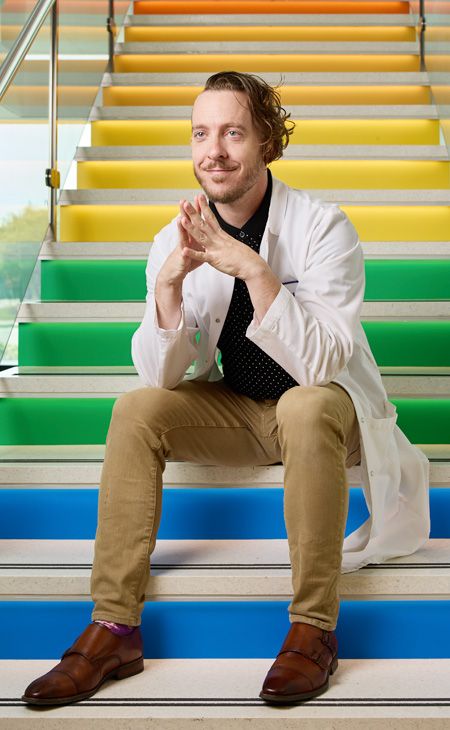
Research and Development Process Engineering, Mars, Inc.
Garrett L. Clark went from being a steel mill engineer to helping to create some of the best-known candies in the world.
Garrett L. Clark (M.A.S. CHE ’11)During the “Great Recession,” Garrett L. Clark (M.A.S. CHE ’11) was asked to step down from his engineering role at an Indiana steel mill and become a line manager instead. Instead of settling, he opted for a slightly different career path—one in which he now creates candies for millions of people around the world.
Clark is now a research and development process engineer for Mars Inc., utilizing the talent he once used to refine steel to soften gum, texturize gummies, and tantalize healthier taffy.
Catering to taste is Clark’s trade, and it requires keeping up with fickle trends and complex processes that can shift in just a matter of months.
Take the current hot trend of textured gummy candy.
“They’ve shaken up the industry with how successful they’ve been,” Clark says. “And it’s relatively easy with a gummy to make iterations: add sour sanding or attach other candies. All those things are relatively inexpensive, from my view as a process engineer, as opposed to making caramel M&M’s.”
The inherent complexities of caramel M&M manufacturing are what keep process engineers such as Clark up at night. You have to keep the caramel hard enough to attach it to a candy shell, yet firm enough to hold its structure—but not so firm that it’s unchewable.
And then that process has to be repeated over and over—millions of times, consistently—while hopefully adhering to the right side of a profit margin.
“Tastes in candy vary by region and by target audience—young adults or older [people]. It’s very difficult to come up with something truly different that fits a need that isn’t being filled by what we have,” says Amy DeJong, a senior process engineer at Mars. “And once you have that idea, it still has to be realistic. That’s where Garrett’s role comes in: finding out if it’s possible, with the right equipment and ingredients.”
Clark must cater to the diverse—and often divergent—tastes of the world. White chocolate is hugely popular in some countries and disliked in others. Gum sold in China is incorporated with tiny bits of tea leaves, which is not as hot a seller in the United States.
There are also contradictory trends. The “better for you” trend is popular now, Clark says, such as adding whey protein to Snickers bars, or adding fiber and vitamins to mitigate any guilt.
“But the opposite is also true,” he says. “Every time there’s a recession in the economy, people want an indulgent treat, a moment of escape.”
It’s Clark’s job to deliver both. But he says that’s the fun of it.
“The thing I love about the candy industry is we associate candy with so many great emotions—happiness, joy, escape. What can we make to make people feel those good emotions?” he says, noting that he works in a lab with a mini production line to crank out test treats, and his team has “a lot of fun.”
“Garrett is really collaborative,” says DeJong. “He’s good at working with different types of people with different roles and goals and things that are important to them. That’s important when working on a complex problem.”
One of Clark’s biggest accomplishments was the creation of Starburst Goodies in 2024. A part of the “better for you” trend, the Starburst gummie had fiber, 70 percent less sugar than a regular Starburst candy, and contained no gelatin or artificial colors or flavors.
“It was a really challenging product, to be able to do 70 percent reduced sugar and still have it taste good,” Clark says, “and no gelatin and still have it have bouncy texture.”
Another accomplishment early in Clark’s time at Mars was making Extra Refreshers gum, a sugar-free gum that he succeeded in making much softer to chew. He received his most treasured praise for that one: his denture-wearing grandmother told him it was the only product she could chew.
“That one really brought it home for me,” Clark says.
Born and raised in Gahanna, Ohio, Clark received his bachelor’s in chemical engineering from Johns Hopkins University and immediately took a job as a steel process engineer at ArcelorMittal, a steel mill in northwest Indiana.
But after the 2010 recession caused a downturn in the steel industry, Clark chose to seek out a new path. He left his job at the steel mill to make Argo Corn Starch at that company’s Illinois factory while pursuing his degree at Illinois Tech. After graduation, he worked at Blommer Chocolate Company, a family owned company whose rooftop cocoa bean roaster has been known to send a chocolatey aroma wafting across all of downtown Chicago.
Mars recruited him in 2014, and he’s been working there since.
Clark, who is gay but was not always open about it in the workplace, helped to start the first LGBTQIA associate resource group at Mars. He says he was heartened by its reception from coworkers.
“There are not a lot of queer engineers. I was always very careful about pronouns,” Clark says. “It took me a while in my career before being fully comfortable coming out. In food processing, I feel they’re more diverse and inclusive.”
He adds, of what’s next, “It’s dangerous to have a dream job this young in my career. As long as the challenge is there, I’m pretty happy. And whenever it gets stressful, we always say, ‘Hey, we’re just making candy!’” —Tad Vezner