

Semper Legalis
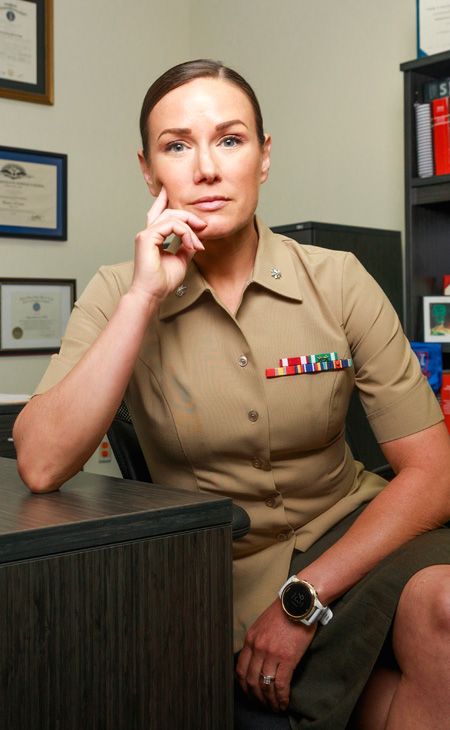
Regional Special Trial Counsel-West, U.S. Marines Corp
Lieutenant Colonel Candace White quit family law to join the United States Marines. Today, she is the lead prosecutor for all serious felony cases involving Marines for half the country.
Candace White (LAW ’09)As a judge advocate in the United States Marine Corps—the Marine equivalent of a JAG officer—Candace White (LAW ’09) spent her first tour of duty prosecuting Marines and sailors for a wide variety of criminal offenses. But after spending years as a prosecutor on the country’s east coast, she was ordered to switch sides in two ways: to argue for the side of the defense, and to do it on the other side of the world.
White had been screened and selected for a special assignment—something that only the top 10 percent of Marine captains get approved for: to get an advanced degree. Upon receiving her specialized Master of Laws (LL.M.) degree, she was then given a highly prominent posting as the regional complex defense counsel in Okinawa, Japan.
In effect, she was the public defender for all “complex cases”—serious felonies such as murder, sexual and domestic assaults, and child abuse—in the entire Pacific region of the globe that includes southeast Asia, Hawaii, and Alaska.
“I didn’t want to go to Japan, and after so many years as a prosecutor I didn’t necessarily want to do defense,” White says. “But there’s a phrase in the Marine Corps: ‘Bloom where you’re planted.’ You’ve got to be open to new experiences and changing your viewpoints. It’s easy to get your blinders on, not just in your legal field, but in society in general.”
As part of her role, White traveled between numerous countries defending Marines.
“I think every prosecutor should do a stint as a public defender. You see a whole other side of the law,” White says. “I learned how to distinguish between your client who allegedly committed a criminal act and a Marine in front of you who is your brother or sister in uniform who you can relate to and empathize with.”
The high-ranking posting in Japan—as well as a learned tolerance for constant adaption—prepared her for a brand-new format of military justice mandated by the U.S. Congress, one in which she would be assigned a role to oversee a huge portion of the country.
A NEW KIND OF COUNSEL
In 2022, as part of that year’s National Defense Authorization Act, otherwise known as the annual U.S. Department of Defense budget, Congress created an Office of the Special Trial Counsel for each branch of the military to tackle major, or “complex,” crimes in the military.
And the offices were placed under direct civilian control. In other words, the offices would operate impartially outside the military command structure, while providing “expert, specialized, independent, and ethical representation of the United States” when prosecuting military personnel.
It was a sea change within the military code of justice.
“I personally think we were doing a good job, but Congress wanted a more standardized measure of prosecutorial experience, as well as heightened independence, for those litigating serious and complex offenses,” White says.
But there was one part of the change White was ecstatic about: for the first time, prosecutors would have discretion over whether to bring a case.
“I had no prosecutorial discretion in my entire career [up] to that point,” White says. “Before, commanders decided if a case would be prosecuted at court-martial or not. Now every allegation and every case involving a complex offense is evaluated by multiple highly trained attorneys. Now I can screen and evaluate based on the merits and evidence and evaluate if criminal prosecution is the appropriate forum given the nature of the offense. These changes are all really good for the military justice system.”
In July, after getting a master’s degree in military studies from Marine Corps University at Quantico Base, Virginia, White was appointed regional special trial counsel-west becoming the lead prosecutor for all complex cases west of the Mississippi River involving Marines. She oversees three teams of Marine attorneys under the auspices of the U.S. Secretary of the Navy, a civilian.
White is only the second person to hold the position.
“Candace is definitely a benefit to our community. Wherever she goes, she makes her mark,” says Lieutenant Colonel Shannon Hesser, a Marine Corps judge advocate for 23 years who operates as a command legal adviser and has known White since they graduated from the same LL.M. program. “She’s on my speed dial for [Office of Special Trial Counsel] issues, and she helps me understand litigation. She’s very passionate, extremely intelligent, and she really likes what she does.”
After graduating from law school, White tried out family law for a few years, in both Illinois and California, but she didn’t enjoy it. Then she saw an ad posting for military judge advocate officers, and she cold called a recruiter.
“Something in the back of my head had always interested me in military law. Public service is very important, volunteer work and civic responsibilities,” White says, adding, “I pretty much let those recruiters relax for a while. Lawyers are very hard for them to get, especially those that are already certified and can meet the physical standards.”
As for why she chose the Marines: “If you’re going to do something, why not be the best?” she says. She was commissioned in 2011.
But there was a catch: Marine lawyers were different from those in other branches of the military. They don’t just go to officer training school; they also have to train to become provisional rifle platoon commanders.
They’re trained not just in the law, but also in combat tactics, weapons systems, basic field medicine, land navigation without GPS systems; they learn everything they would need to command a platoon in case of a conflict. Officer candidate school has a high attrition rate, with male and female candidates evaluated on the same scale in both mental and physical fitness. Of the 72 women who entered White’s course, she says, only 36 completed it.
“As Marine Corps officers, we’ve gone through the same training as other Marines. It’s very important to us. It carries a lot of credibility,” says Hesser. “Being an officer in the military, you must have integrity, especially as a lawyer. Candace has an incredible amount of integrity, and it’s very natural.” —Tad Vezner