

The Trend Finder
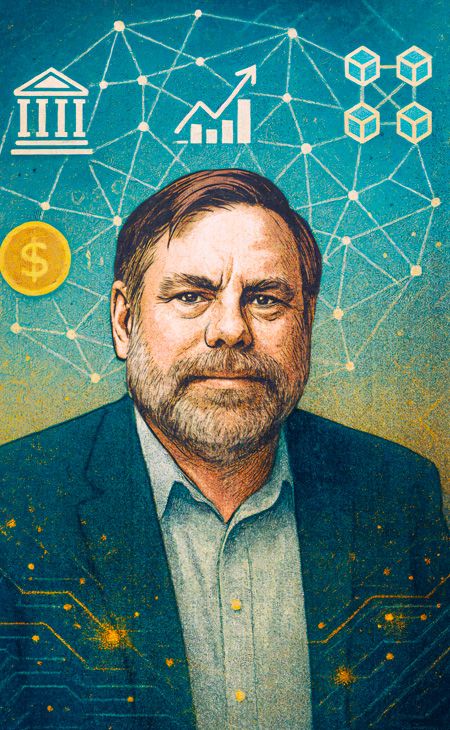
Managing Director of Education, RIA Channel
Keith Black has worked in the financial world for decades, focusing on “alternative” investments. His recently published eighth book taps into that same expertise, looking at the viability of cryptocurrencies.
Keith Black (Ph.D. MSC ’10)Keith Black (Ph.D. MSC ’10) has spent decades working in the financial industry as everything from a floor trader and an equity analyst to the director and curriculum writer for a major analyst credentialing organization. He’s now written his eighth book about investment strategies and risks—this time tackling the timely topic of when and how to invest in cryptocurrencies.
Investing in Cryptocurrencies and Digital Assets: A Guide to Understanding Technologies, Business Models, Due Diligence, and Valuation, published in 2025 by John Wiley & Sons, is about “how to do your homework to decide if a digital asset is a wise investment,” Black says, adding, “Most people should invest less than 5 percent of money in crypto. There’s definitely risks here, and I try to point out where the risks are and where the limits should be.”
Black points out that “alternative investments”—meaning assets other than stocks and bonds—now make up $20 trillion globally, compared to more than $200 trillion for the global stock and bond markets. Such alternative investments include real estate and hedge funds, as well as a growing interest in cryptocurrencies, which now comprise $4 trillion in assets.
“Sophisticated investors have been increasing allocations to alternative investments for more than twenty years,” Black says.
Josh Kernan, who was head of alternative investments at Charles Schwab for 15 years before co-founding the San Francisco-based investment management firm Permian Capital Management, says of Black, “He’s the guy who wrote the materials I was studying....I actually think it’s incredible the amount of content he’s been able to put out there.”
Adds Kernan, “He’s someone who knows all the different alternative investments at a master level, but Keith is unique because he’s someone who has a teaching-level knowledge of crypto and he’s used his background
in tech and business to get there. He’s far more advanced than his peers because of that.”
Black notes that there are now 18,000 different kinds of cryptocurrencies, “some of which are worth something and most of which are not.”
Technology often operates on the idea of winner-take-all, Black says.
In most industries, the dominant market share rests in the top two to five players. Bitcoin is still king, making up $2.7 trillion in assets; Ethereum is a distant second at half a trillion dollars. Black says that perhaps 100 of today’s digital assets will have long-term value; as for the rest, buyer beware.
He points to one of the biggest victims of the dot-come crash as a useful case study.
“Just like in 1999 with pets.com, more than 90 percent of today’s cryptos are worthless—but there are some real businesses in the crypto space,” Black says. “The lesson of my book is: don’t buy meme coins, don’t invest more than you can afford to lose, and do your homework.”
For instance, Black points to one business that allows people to borrow or lend money by using their crypto holdings as collateral. That business now commands $40 billion in crypto borrowing and lending, and may have long-term value similar to a medium- to large-sized bank.
When it comes to crypto as a whole, “People like the scarcity of the asset, that it’s not beholden to any government. If you live in Ukraine or Venezuela or Zimbabwe, you could be concerned about your home country’s currency or banking system,” Black says. “This idea of a non-governmental stored value asset is very appealing, especially in countries with problems with property rights or unstable banking systems.”
On a deeper level, many see crypto as a component of the newest potential version of the internet known as “Web3.” Where “Web1” was the early internet with basic read-only, static text and dialup capability, “Web2” is the modern social media era, where users can interact with content.
“Web3” is a decentralized version of the web that allows users to take ownership and monetize their own assets outside social media ecosystems.
From a financial standpoint, “People who built the internet didn’t make any money for making it. They built hypertext and all this plumbing, but never commercialized the plumbing so it doesn’t cost you a fraction of a cent to send email,” Black says. “Because it’s free, companies such as Google or Facebook can monetize it. You don’t own your own data.”
“The idea of crypto or Web3 is [that] you own your content. It’s
your personal asset, you can choose to monetize it or not—up to you,” Black says.
Back in 1990 Black began his career as a commodities trader at First National Bank of Chicago. He traded options on the floor of the Chicago Board Options Exchange before moving upstairs to build quantitative equity models, forecasting the value and growth of stocks in various sectors.
Black then spent a large portion of his career as both the managing director and curriculum director of the Chartered Alternative Investment Analyst Association, a professional trade organization with 14,000 members worldwide. While there, he co-authored six books that served as the organization’s credentialing curriculum.
Black now works as the managing director of education for RIA Channel, which offers white papers, courses, webcasts, and video content on financial and investment trends. —Tad Vezner