

Illinois Institute of Technology
       
 
Prospective Students Current Students Business & Industry Faculty & Staff Alumni Visitors


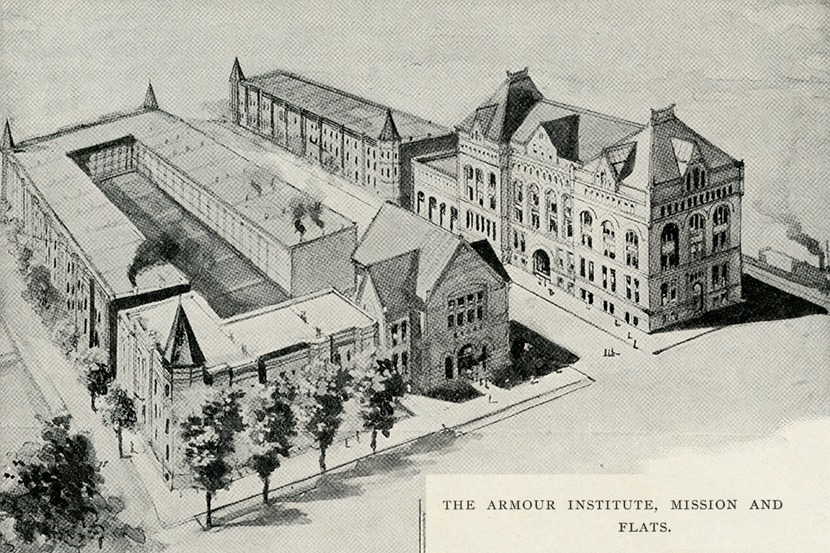
In 1890, when advanced education was often reserved for society's elite, Chicago minister Frank Gunsaulus delivered what came to be known as the "Million Dollar Sermon." From the pulpit of his South Side church, near the site Illinois Institute of Technology (IIT) now occupies, Gunsaulus said that with a million dollars he would build a school where students of all backgrounds could prepare for meaningful roles in a changing industrial society. Philip Danforth Armour, the Chicago meat packer and grain merchant, heard Gunsaulus' sermon and came to share the minister's vision. He agreed to finance the endeavor with the stipulation that Gunsaulus become the first president of Armour Institute.

When Armour Institute opened in 1893, the institute offered professional courses in engineering, chemistry, architecture and library science. IIT was created in 1940 by the merger of Armour Institute with Lewis Institute (est. 1895), a West Side Chicago college that offered liberal arts as well as science and engineering courses. The Institute of Design, founded in 1937, merged with IIT in 1949.


In 1969, IIT became one of the few technology-based universities with a law school when Chicago-Kent College of Law, founded in 1887, became an integral part of the university. Stuart School of Business was added in 1969, with a gift from the estate of Lewis Institute alumnus and Chicago financier Harold Leonard Stuart. The school became the Stuart School of Business in 1999. Midwest College of Engineering, founded in 1967, joined the university in 1986, forming the nucleus for IIT's west suburban campus.

Today, IIT is a private, Ph.D.-granting university with programs in engineering, science, psychology, architecture, business, design and law. One of the 16 institutions that comprise the Association of Independent Technological Universities (AITU), IIT offers exceptional preparation for professions that require technological sophistication. Through a committed faculty and close personal attention, IIT provides a challenging academic program focused by the rigor of the real world.


The university and its contract research affiliate, IIT Research Institute (IITRI), have an annual research volume of $130 million. Current research strengths include fluid dynamics and aerospace, synchrotron radiation science, environmental engineering and regulatory policy, polymer science and recycling, food safety and technology, and transportation and infrastructure.

IIT has more than 38,000 living alumni and is known as the alma mater of accomplishments as well as of people. IIT and IITRI scientists and engineers have made some of the century's most important technological advances, such as the invention of magnetic recording and the development of re-entry technology for spacecraft. IIT architects have shaped the skyline of Chicago and cities throughout the world.

IIT Research Institute has several locations throughout the United States, and the university has four campuses in the Chicago area. The 120-acre Main Campus, at 33rd and State in Chicago, as well as many of its buildings, was designed by Ludwig Mies van der Rohe, who directed the architecture program at IIT from 1938 to 1958 and was one of the 20th century's most influential architects. In 1976, the American Institute of Architects recognized the campus as one of the 200 most significant works of architecture in the U.S.

The state-of-the-art, 10-story Downtown Campus at 565 West Adams Street houses Chicago-Kent College of Law, the Center for Law & Financial Markets, the Master of Public Administration Program, and the Stuart School of Business.

The Institute of Design, an international leader in teaching systemic, human-centered design, is located at 350 N. LaSalle Street in Chicago's Near North neighborhood.

The 19-acre Daniel F. and Ada L. Rice Campus in Wheaton complements area community colleges, serving west suburban residents and employees in Illinois' high-tech corridor by offering graduate programs, upper-level undergraduate courses, and continuing professional education.

The five-acre Moffett Campus in Bedford Park houses the National Center for Food Safety and Technology, a unique consortium of government, industry and academia that seeks to improve the quality of our nation's food supply.

Check out these current facts about IIT.

 
© 2008 Illinois Institute of Technology 3300 South Federal Street, Chicago, IL 60616-3793 Tel 312.567.3000