Asking Questions for Social Impact
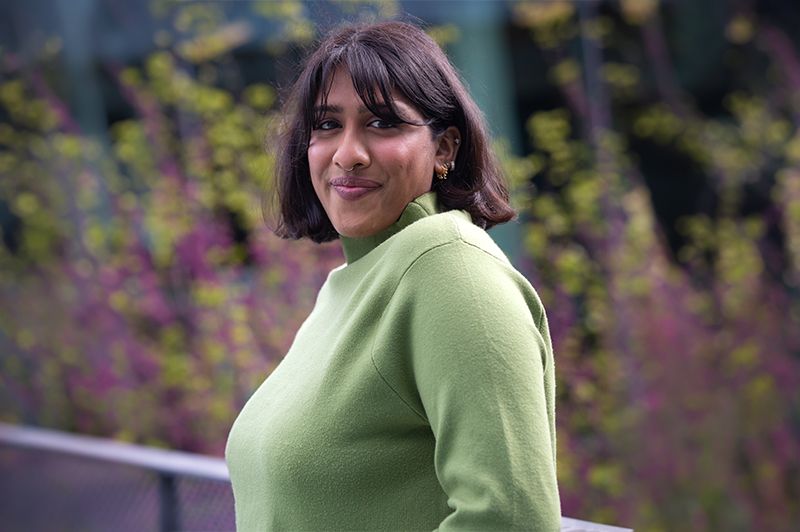
While working at a business consulting firm serving the health care and public service sectors straight out of her undergraduate degree program, Rhea Shah (MDes ’25) realized that when tackling her projects, she often had more questions than answers. With a bachelor’s in mechanical engineering under her belt, Shah had a firm grasp of the research, analysis, and execution of her position, but she couldn't help but ask herself “How?” and “Why?” throughout the development process.
“All I could think about was, ‘How is this going to live when we deploy it? Have we even talked to a user yet?’” she says. “I felt like I had these thoughts and questions and no answers.”
Shah did some research and realized that she was missing a crucial lens to understanding the user experience—design. Eager to learn more about its potential influence in her profession, Shah began looking for Master of Design programs that could help her expand her thinking and answer her questions.
“I wanted a program that would give me a bit of a crash course on the elements and the areas of design,” she says. “I also wanted a program where I felt like the courses were taking it up a notch.”
When she discovered the Institute of Design at Illinois Tech, everything began to fall into place. Seeing the variety and depth of the areas that she could explore ignited her passion to study design even further. She decided to enroll and explore design for social innovation and impact.
Coming from a health care background, says Shah, “something that continued to resonate with me was still wanting to help people. I want [my career] to be something that’s systematically impactful so that I leave something better than I found it.”
At ID, Shah’s drive to help others remained top of mind when diving into the curriculum. She started to learn about concepts that she had always thought about and was finally able to experience—including the politics of design, feminist design, systems of care and care models, and equitable design.
“Every time I walked into class, my mind was just continuously blown,” she says.
Shah eventually joined Associate Professor Kim Erwin at the Equitable Healthcare Lab as a design researcher. As part of the lab’s work, she helped conduct research on the power of attorney system for young people, as well as on how designers conduct pilot testing in health care spaces. This work included helping to create a database of resources and tools on the subject. The work ultimately culminated into a larger research initiative that focused on how designers across all industries think about testing, the language that structures that testing, and more.
As she continued to progress through the program, she found herself feeling increasingly worried about how much social innovation she could realistically impact due to changes to certain social, federal, and economic systems that she says weren't always just.
But the collective, optimistic attitude of innovation and reformation among her peers and ID faculty, as well as coursework in revolutionary design principles and systems, kept her grounded in the reason she was studying social innovation in the first place: to make a difference in people’s lives. The unjust systems and threats that she once viewed as obstacles soon became a reason to work to develop human-centered solutions.
“It ignited [the idea that] ‘No, we can be that change.’ We can be the people who bring the reasoning to the chaos. We can be the people who bring the optimism to it. Sometimes it takes sitting through the bad and using your ability to be creative and to think expansively to make it good,” she says.
Recently accepting a position as an experience strategist at ZS, a Chicago-based consultancy that works primarily in the health care space, Shah looks forward to tying her research background in with her design thinking skills to generate solutions for today and tomorrow’s challenges in health care.
“It’s been four years in the making: pursuing this path, adding this new lens to do the work that I want to do, having the job I have now, and having the opportunity to answer the questions I asked four years ago,” she says. “I’m really looking forward to what this chapter will bring and the new questions I’ll get to answer.”