

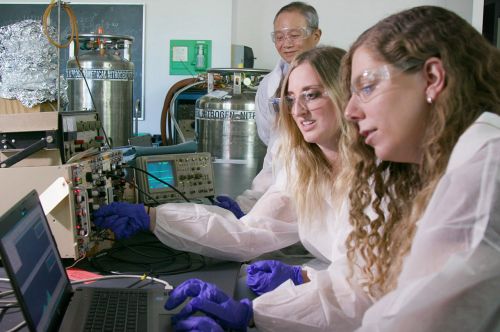
Health Physics (M.A.S.)
Advance your career in the nation’s second-largest health physics program. Master the advanced technical skills and regulatory knowledge needed to safeguard human health and the environment.
Power Your Career in Nuclear Security with Illinois Tech’s M.A.S. in Health Physics
Professionals who have the skill set to work with nuclear materials, whether that’s at nuclear facilities that will power the next generation of technologies or in medical facilities, will be in demand. In Illinois Tech’s M.A.S. in Health Physics program, you’ll learn from experienced health physicists who will help you develop the technical skills to detect and measure radiation, the regulatory knowledge to navigate complex laws, and the leadership to guide teams in high-stakes environments—all on your schedule. Courses are fully online and created with your schedule in mind, and will prepare you to gain critical certification and to advance your career.
Program Overview
Illinois Tech’s Master of Applied Science in Health Physics provides an occupation-focused path that seamlessly bridges advanced scientific theory with real-world application. The 31-credit-hour program spans six flexible terms (two each in the spring, summer, and fall), allowing you to begin your studies when the timing is right for you and graduate in as little as 12 months. All required coursework can be completed fully online, featuring a dedicated virtual lab component that delivers hands-on instrumentation training and practical field experience without requiring you to pause your professional career.
To support your career progression, the program offers:
- Direct preparation for milestones including the Certified Health Physicist (CHP) examination
- Comprehensive competencies covering radiological hazard mitigation, environmental assessment, and expert risk communication
Career Opportunities
Graduates of the M.A.S. in Health Physics step directly into high-impact leadership and safety roles within hospitals, nuclear energy facilities, national laboratories, and regulatory agencies. The curriculum prepares you for elite technical positions, including:
- Radiation Safety Officer
- Medical Health Physicist
- Health and Safety Specialist
Our rigorous curriculum ensures that you can identify radiological hazards, apply sophisticated mathematical tools, and communicate risk confidently to both technical teams and the public. Key courses in the program include:
- PHYS 550 Radiation Instrumentation Laboratory Understanding radiation begins with knowing how to detect and measure radioactive material. While being introduced to electronic tools ranging from rate meters and scalers to high-speed multi-channel analyzers, you’ll learn in this course how health physics professionals in hospitals, research labs, and nuclear facilities gather accurate data—in conjunction with computer-based applications—to apply solutions to practical problems.
- PHYS 573 Standards, Statutes, and Regulations Once you understand how to detect and measure radiation, it’s crucial to understand the rules and regulations that apply in the United States and internationally. By being able to navigate overlapping requirements, you’ll understand the effect that regulatory agencies have upon the future of organizations, as well as the consequences of noncompliance.
- PHYS 576 Radiation Dosimetry Fundamental to evaluating radiation hazards and risks to humans, this course explores how to quantify both external and internal radiation doses. This is a key bridge between understanding the science and implementing safety protocols in real-world contexts
You must complete the Illinois Tech graduate application, regardless of which graduate program you wish to pursue. Visit our admission website to learn more about what information and documents you need to apply.
A bachelor’s degree in physics, chemistry, biology, or engineering is required with an overall GPA of 3.0/4.0. Please contact the Health Physics department with any questions.
Tuition and Fees
To learn more about the university’s general tuition and fees, visit the Student Accounting website.
Featured Faculty

David Scherer

Bryce Littlejohn

Andrew J. Howard
“I had a great experience working with the faculty. I feel as though I will have people to reach out to in the future if I ever have questions in my field or need something such as a recommendation. Meeting up with the faculty at the national (Health Physics Society) meetings every year also helped to make me and the other students feel comfortable. It creates a family like atmosphere that I think is unique to the Illinois Tech health physics (program). Even the administration were crucial in making everyone feel accepted and like a family.”


Lexi Detweiler’s job is critical, to put mildly. At the Y-12 National Security Complex in Oak Ridge, Tennessee, she works on a team whose job it is to fuel the nuclear-powered United States Navy, to help maintain its nuclear stockpile, and to conduct nuclear non-proliferation work.
Lexi Detweiler (PHYS, ASPY, M.S. HP ’21)
Inspired by his passion for physics, Will Limestall is working to develop clean energy sources.
Will Limestall (PHYS, ASPY ’18, M.S. HP ’18, Ph.D. PHYS Candidate)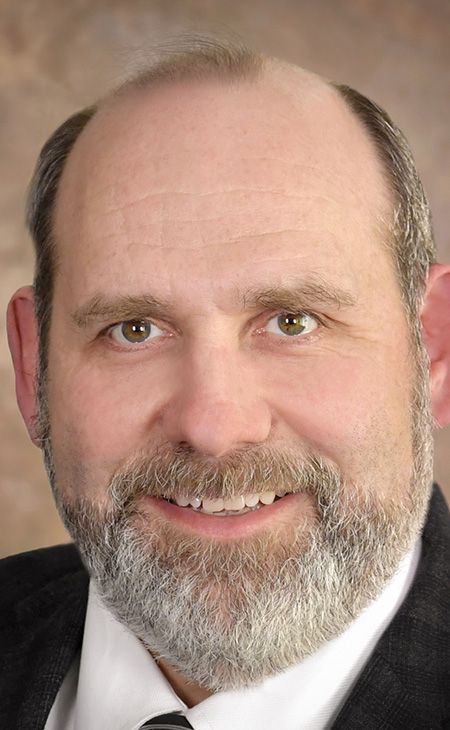
Get In Touch
To learn more about the program, please reach out to program director David Scherer at dscherer1@illinoistech.edu.
Frequently Asked Questions (FAQs)
How long is the M.A.S. in Health Physics program at Illinois Tech?
The program is 31 credit hours with six terms. Students can complete the M.A.S. in Health Physics in as little as 12 months.
How does Illinois Tech's M.A.S. in Health Physics prepare me for a future career?
Illinois Tech's M.A.S. in Health Physics prepares you to take the Certified Health Physicist (CHP) examination, which is required in order to receive the official title of Certified Health Physicist in the United States.
Can I take the M.A.S. in Health Physics online?
Yes, Illinois Tech's M.A.S. in Health Physics is offered completely online with your schedule in mind.