Research on the Cyber Battlefield
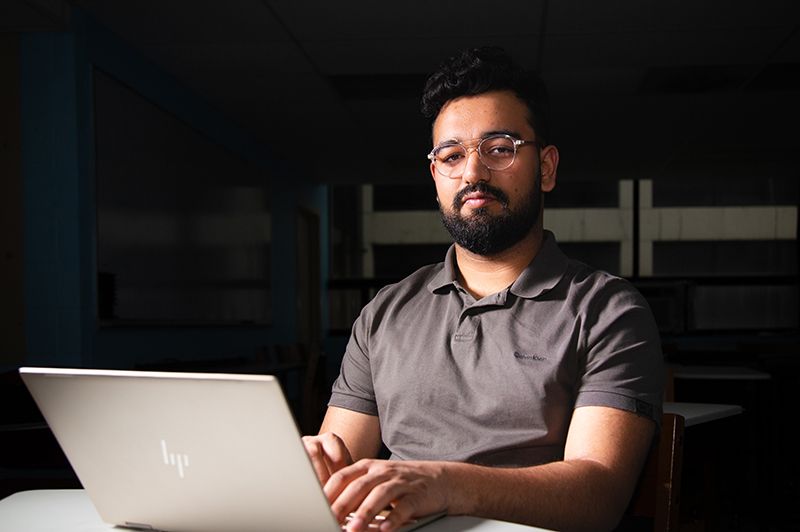
Abdul Hadi Khan (M.A.S. CYF ’26) discovered a passion for cybersecurity research while working side-by-side with Illinois Tech faculty and students, and how it can bolster the United States’s national security interests.
“I have been actively involved in research, resulting in multiple publications, including ‘Designing SecureAI Curriculum for National Security Needs: The Illinois Tech Program of Study,’ which outlines a curriculum to secure artificial intelligence systems,” Khan says. “I also published work on cyber defense of space systems and AI-driven psychological operations in military journals of the Romanian Army and Finnish Defense Forces.”
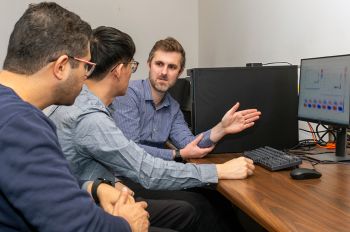
He has conducted and published the research alongside peers and Illinois Tech Associate Professor of Information Technology and Management Maurice Dawson, who also directs the C2SAFE cybersecurity research center.
Khan’s research directly advances federal priorities in AI-driven cybersecurity and the protection of space as critical infrastructure. By developing technical frameworks to secure the intersection of space, cyberspace, and the cognitive domain, his research provides the strategic capabilities necessary to strengthen U.S. national security. His work ensures the nation’s competitive edge and protects essential national interests against sophisticated autonomous threats and psychological operations. Through his research on topics such as designating space as a critical infrastructure and advancing AI-driven cybersecurity, Khan aims to contribute to national security and global resilience.
“These experiences significantly strengthened my confidence and technical depth,” Khan says. “Illinois Tech has prepared me through meaningful research opportunities and hands-on industry exposure, positioning me well for advanced research and future academic pursuits.”
A paper that Khan wrote with Dawson and Cedric Nartey (ITM/M.A.S. CYF 4th Year), titled “Weaponising the Mind: AI, Cyberspace, and the Future of Psychological Warfare,” traces the shifts in psychological warfare from World War II to present-day disinformation campaigns, highlighting how adversaries exploit democratic transparency to undermine public trust. The paper also explores how AI has added to the toolkit and changed how psychological operations work across physical, digital, and emotional platforms.
“This research project was interesting because it helped me understand how warfare has changed from traditional to multi-domain settings,” he says. “I learned about the shift from World War II radio propaganda used to boost national pride and rally citizens to modern AI-driven influence operations and the need to make citizens aware and to protect them from misinformation and foreign influence campaigns.”
The team examined how propaganda has morphed from posters, state-run broadcasts, and educational programs to modern techniques that utilize social media campaigns and news outlets, which makes it more difficult for the propaganda’s targets to distinguish it as propaganda.
“Professor Dawson’s research in psychological operations, space system defense, and IoT security has helped me to brainstorm about critical topics,” Khan says. “His military experience gave us a unique view of cyberspace as the fifth battlefield, which made it possible to do a full analysis of psychological operations using digital infrastructure and AI tools like neural networks and (natural language processing) tutors.”
Another of his research papers, “AI-Powered Cybersecurity Models for Training and Testing IoT Devices,” explored how AI can help secure the diverse IoT space. It outlines a realistic and comprehensive assessment of AI cybersecurity model performance, focusing on both detection efficacy and cross-domain generalization for IoT, industrial IoT, medical IoT, Message Queuing Telemetry Transport, and Edge-IIoT devices.
As he prepares to graduate from Illinois Tech’s cybersecurity master’s program, Khan says that the way that it integrates applied learning and research-driven education has prepared him for a career solving real-world problems. Professors in the program who are not only academic experts, but also active industry professionals make the learning experience practical and impactful, Khan says.
CyberHawks, Illinois Tech’s cybersecurity student organization, played a major role in helping Khan work toward his career goals. He says hands-on sessions that included real-world exercises testing cybersecurity systems led by John Ford (ECE, M.S. ECE ’23), who returned to mentor and prepare the team for competition, helped to advance his skills.
“The combination of advanced research and applied cybersecurity training through CyberHawks left the biggest impression on me,” he says. “Bridging academic research with real-world offensive and defensive security practices showed me how impactful cybersecurity work can be when theory and practice come together.”