Third Successful Implantation of Wireless Visual Prosthesis Brain Implant Advances the Frontier of Artificial Vision
Illinois Tech’s groundbreaking brain implant continues to redefine possibilities in providing artificial vision for individuals with blindness
CHICAGO—May 7, 2026—In a major milestone for the field of neurotechnology, the Intracortical Visual Prosthesis (ICVP), a revolutionary wireless brain implant that bypasses the retina and optic nerves to connect directly to the brain’s visual cortex to provide artificial vision, has been successfully surgically implanted in the ICVP study’s third participant.
This surgery, performed at Rush University Medical Center, underscores the scalability and robustness of the system, marking a new chapter in advancing vision restoration for individuals with total blindness.
The ICVP system was developed by a multi-institution team led by Philip R. Troyk—executive director of the Pritzker Institute of Biomedical Science and Engineering at Illinois Institute of Technology, professor of biomedical engineering—and represents the culmination of nearly three decades of Illinois Tech research dedicated to ultimately providing artificial sight to those with blindness due to eye disease or trauma.
Recently showcased in PBS’s NOVA episode “Building Stuff: Boost It,” the ICVP project highlights Illinois Tech’s leadership in pioneering neurotechnologies that amplify human capabilities. The project also featured prominently at a Society for Neuroscience (SfN) 2024 symposium, where researchers presented findings highlighting the profound implications of brain-implanted technologies for vision restoration.
Third Participant Successfully Implanted With Wireless Visual Prosthesis
The Intracortical Visual Prosthesis System is the first intracortical visual implant to use a group of fully implanted miniaturized wireless stimulators to explore whether individuals with blindness can utilize the artificial vision provided by this approach.
This visual prosthesis system allows devices to be permanently implanted, which is a unique advantage that provides researchers ample time to explore how the device can effectively work, and for the recipient to learn how the device can be useful.
During the preclinical phase, the Illinois Tech team worked with Rush University Medical Center neurosurgeons to develop and refine surgical procedures, culminating in this week’s successful implantation of 34 stimulators with a total of 544 electrodes in an individual with blindness. The clinical phase is aimed at testing whether this prosthesis will provide study participants with an improved ability to navigate and perform basic, visually guided tasks. Testing will commence at The Chicago Lighthouse’s Hilton Center for Prosthetic Research, which is serving as the research home throughout the ICVP clinical trial, after a 4-week recovery period.
“The success of this third implantation of the ICVP represents an important step forward in offering a meaningful option for patients with profound vision loss,” said Dr. Sepehr Sani, the surgeon who implanted the device.
“This project underscores the immense possibilities of neurotechnology—by translating decades of research into real-world applications, we are forging new pathways to enhance lives,” says Troyk. “The third successful implantation demonstrates the scalability and robustness of the ICVP system. We’re driven by the potential of this technology to restore autonomy and improve the quality of life for individuals living with blindness. This novel brain interface technology has potential applications for other neural conditions, including those in the spinal cord, and we are pursuing those as well.”
Groundbreaking Implant Technology Aims to Transform Lives for Individuals Living with Blindness
Since many individuals affected by total blindness do not have intact retina or optic nerves but retain the visual cortex—the area of the brain that allows people to see—an intracortical visual prosthesis may be the only possible advanced visual sensory aid from which they can benefit.
While the brain works as a powerful processing system and receives millions of nerve signals from the eyes, if the eyes are no longer able to communicate with the brain, Troyk says that researchers can “intervene by bypassing the eye and optic nerve and going directly to the area of the brain called the visual cortex.”
Earlier this year, the project marked four years of successful clinical testing following the first implantation of the device, finding the prosthesis provides study participants with an improved ability to navigate and perform basic, visually guided tasks.
“For people who are completely blind, even the ability to perceive a small amount of light can profoundly impact their daily lives,” said Janet P. Szlyk, President and CEO of The Chicago Lighthouse. “The results from this research open doors to transformative advancements in blindness research and vision restoration.”
A Call for Continued Innovation and Collaboration
As the ICVP moves forward, Illinois Tech is actively seeking new participants for ongoing studies, aiming to broaden the understanding and capabilities of artificial vision. This call for participation is not just an invitation to be part of cutting-edge scientific research but also a step towards building a more inclusive future where technological advancements pave the way for new forms of sensory experience.
Illinois Tech's pioneering work with ICVP, especially in the landscape of emerging neurotechnologies, positions the institution and its partners at the forefront of creating meaningful, ethical, and transformative solutions for individuals affected by total blindness. It underscores the importance of collaborative, multidisciplinary efforts in pushing the boundaries of what's possible in science and technology, with a keen eye on the societal and ethical implications of these advancements.
“Phil Troyk’s work on the ICVP is a powerful example of Illinois Tech research at its best: deeply interdisciplinary, technically ambitious, and focused on improving lives," said Jeff Terry, vice provost for research at Illinois Tech. “As someone who has been diagnosed with palinopsia, I have a personal appreciation for how much remains to be understood at the interface of the eye and the brain. That makes it especially meaningful to see the potential of neurotechnology not only to restore aspects of vision, but also to open new pathways for addressing diseases and disorders that affect visual perception. This milestone reflects the extraordinary persistence of our researchers and partners, and the promise of collaboration in turning bold ideas into transformative health solutions.”
Illinois Tech is collaborating with Rush University Medical Center, The Chicago Lighthouse, the Wilmer Eye Institute at Johns Hopkins, the University of Texas at Dallas, Microprobes for Life Science, Sigenics Inc., and The University of Chicago on the initiative, with Troyk serving as the principal investigator.
The project is calling for research volunteers who lost their vision as an adult but who had normal or near-normal vision for at least the first 10 years of life. Following surgery and approximately one month of surgical recovery, participants will be studied for 1-3 years, depending on the date of implantation. Learn more at chicagolighthouse.org/requesticvp or email ICVP@illinoistech.edu.
Disclaimer: Research reported in this publication was supported by the NIH (BRAIN) Initiative under Award Number UH3NS095557. The content is solely the responsibility of the authors and does not necessarily represent the official views of the National Institutes of Health.
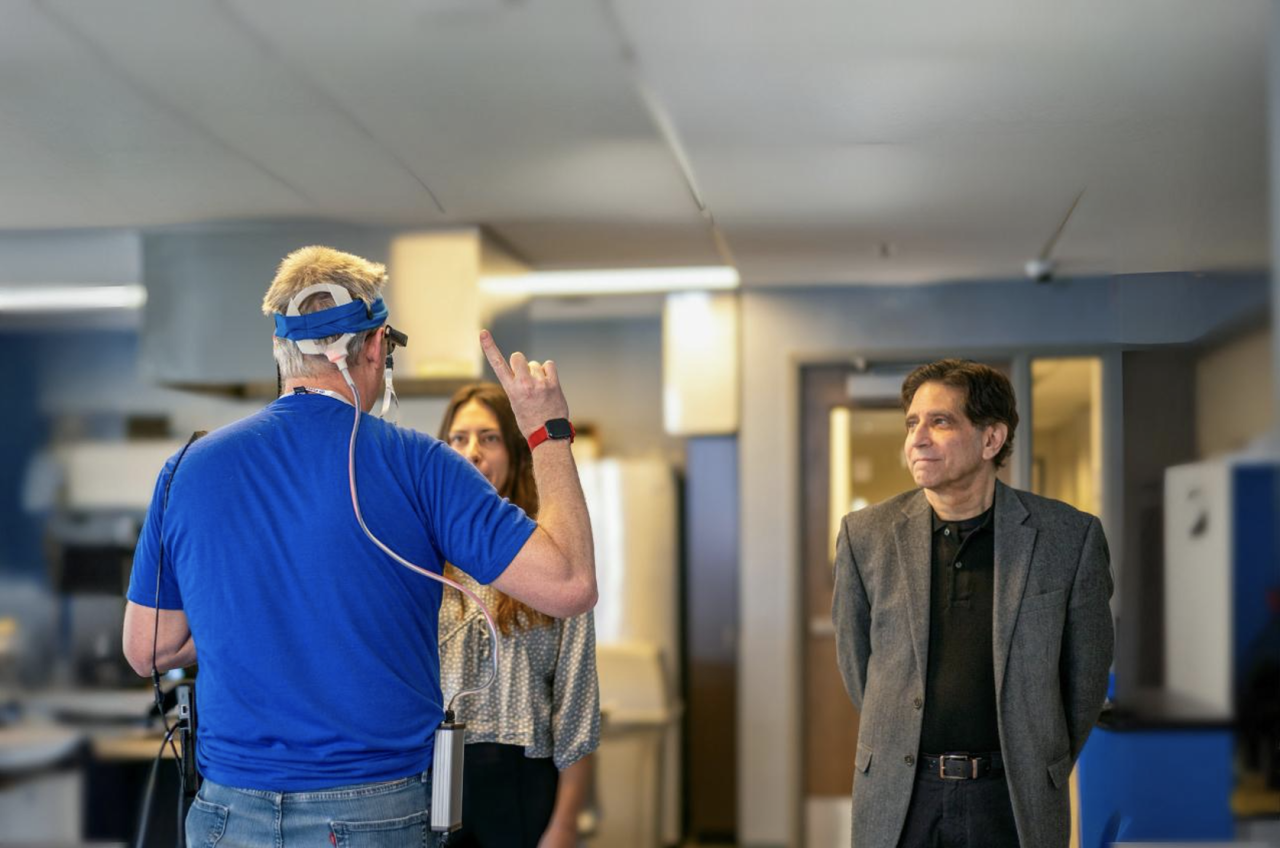
Photo: Dr Phil Troyk supervises device testing with the first study participant at Chicago Lighthouse. For high resolution images suitable for publication, please contact press@illinoistech.edu.
Available for interview
Dr. Philip Troyk, executive director of the Pritzker Institute of Biomedical Science and Engineering, professor of biomedical engineering at Illinois Institute of Technology
Dr. Janet Szlyk, president and CEO of The Chicago Lighthouse
Illinois Institute of Technology
Based in the global metropolis of Chicago, Illinois Tech was born to liberate the power of collective difference to advance technology and innovation for all. It is the only tech-focused university in the city, and it stands at the crossroads of exploration and invention, advancing the future of Chicago and the world. It offers undergraduate and graduate degrees in engineering, computing, architecture, business, design, science and human sciences, and law. Illinois Tech students are guaranteed access to hands-on experiences, personalized mentorship, and job readiness through the university's one-of-a-kind Elevate program. Its graduates lead the state and much of the nation in economic prosperity. Its faculty and alumni built the Chicago skyline. And every day in the city's living lab, Illinois Tech fuels breakthroughs that change lives. Visit iit.edu.
Pritzker Institute of Biomedical Science and Engineering
The Pritzker Institute of Biomedical Science and Engineering (Pritzker Institute) is located on the campus of Illinois Tech (www.iit.edu) in the Chicago South Side neighborhood of Bronzeville. The Pritzker Institute was the brainchild of Robert Pritzker who, in the early 1980’s, envisioned a research organization that could bring technological advances to the clinic. In this respect, he was 20 years ahead of the eventual realization at the National Institutes of Health that translational research is an essential part of the United States medical research portfolio. The current mission of the Pritzker Institute is one of clinical translation by forming relationships between Illinois Tech and external entities to enable multidisciplinary research.
Chicago Lighthouse
The Chicago Lighthouse is a world-renowned social service organization serving the blind, visually impaired, disabled and Veteran communities. Recognized as a pioneer in innovation since 1906, The Chicago Lighthouse provides vision rehabilitation services, education, employment opportunities and assistive technology for people of all ages.
Rush University Medical Center
Rush University Medical Center is an academic medical center that includes a 671-bed hospital serving adults and children, the 61-bed Johnston R. Bowman Health Center and Rush University. For more than 180 years, the Medical Center has been leading the way in developing innovative and often life-saving treatments. Today, Rush is a thriving center for basic and clinical research, with physicians and scientists involved in hundreds of research projects developing and testing the effectiveness and safety of new therapies and medical devices. The Medical Center also offers more than 70 highly selective residency and fellowship programs in medical and surgical specialties and subspecialties.
Media contacts
Petra Kelly
Communications Director
Illinois Institute of Technology
Cell: 773.771.1064
petra.kelly@illinoistech.edu
press@illinoistech.edu
Kevin Dollear
Communications Manager
Illinois Institute of Technology
Cell: 773.860.5712
kdollear@illinoistech.edu
Aaron Baar
Senior Director of Advancement
The Chicago Lighthouse
Phone: 312-997-3662
Aaron.Baar@chicagolighthouse.org
Tobin Klinger
Director of Media Relations
Rush University Medical Center
Cell: (312) 947-1879
Tobin_Klinger@rush.edu