

What Is a "Second Brain"? How Karpathy's LLM Wiki Reveals the Most Future-Proof Skill in AI
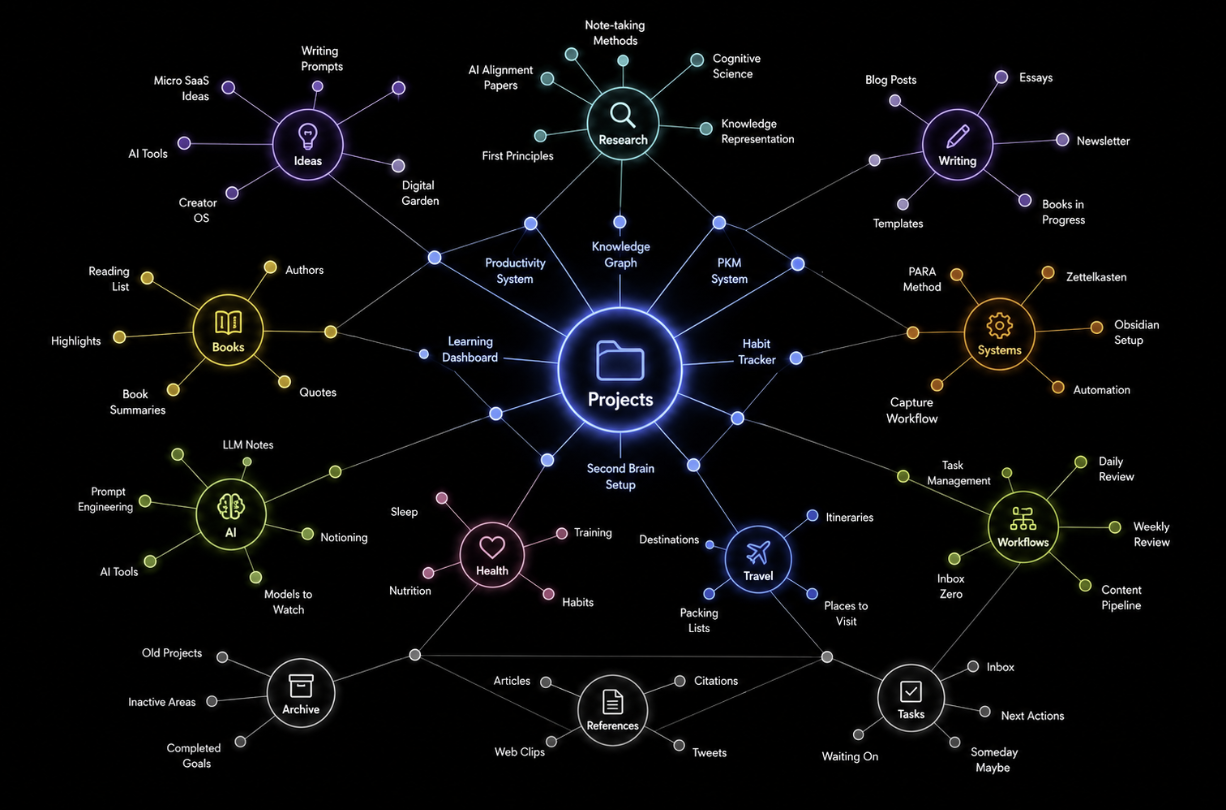
A plain folder of text files has quietly become one of 2026's hottest AI ideas. Here's what a “second brain” (or “LLM wiki”) is, how to build one, and why it shows that the AI future belongs to people who can connect ideas across disciplines—not only to those who build the models.
On April 2, 2026, artificial intelligence researcher Andrej Karpathy—a co-founder of OpenAI and former director of AI at Tesla—posted on X about something he’d been finding surprisingly useful: using large language models (LLMs) to build personal knowledge bases out of plain text files. He called it an “LLM wiki.” The post drew nearly 20 million views and set off a wave of YouTube tutorials and Obsidian walkthroughs on how to build your own.
Then things got interesting. Within a few weeks, Meta revealed that it had rolled out an internal “AI second brain” to more than 60,000 employees. And Google published the Open Knowledge Format, an open standard designed to formalize exactly this pattern. Three very different players—an independent researcher, a social-media giant, and a cloud provider—converged on the same idea in a single quarter.
The upside for anyone deciding what to study or how to build a career: the hottest AI workflow of 2026 isn’t a bigger model or a slicker autonomous agent. It's a folder of text files that a human organizes and an AI reads. And that says something important—and genuinely hopeful—about where the durable opportunities in AI actually are.
In short: A “second brain” is an external, organized store of your knowledge—notes, documents, decisions, ideas—that you can offload thinking into and return to later. An “LLM wiki” is a second brain built so an AI can read and reason over it: plain markdown files, arranged in folders, that a model can query, summarize, and cross-reference on your behalf. The deeper lesson is that the value doesn’t live in the AI. It lives in the human judgment that decides what knowledge matters, how it connects, and which questions to ask. That judgment is a learnable skill—and one of the most future-proof bets in the AI era.
What is a “second brain,” exactly?
The phrase predates the current AI moment. Knowledge workers have long kept “second brains”—external systems that hold what a single human memory can’t. The analog ancestor is the Zettelkasten (“slip box”), a linked index-card method famously used by sociologist Niklas Luhmann to produce a staggering volume of work. The modern popularizer is Tiago Forte, whose book Building a Second Brain introduced the widely used PARA method: organize everything into Projects, Areas, Resources, and Archives.
The promise is simple: stop losing what you learn. Capture ideas once, organize them so you can find them, and let your past thinking compound instead of evaporating. In practice, though, these systems have always had a catch—maintenance. Linking notes, updating cross-references, and filing things where they belong is tedious, so most people quietly abandon their second brain within a few months.
That is precisely the catch that AI removes.
What is an LLM wiki, and why is everyone suddenly talking about it?
Karpathy’s insight was to flip the relationship between you and your notes. Instead of you maintaining a knowledge base and occasionally asking an AI about it, the AI helps build and maintain the knowledge base for you. You collect raw material—articles, meeting notes, book takeaways, research—drop it into a folder of plain markdown files, and point a capable coding agent (Karpathy uses Claude Code) at it. The model reads your files, writes summary pages, creates entries for key people and concepts, and cross-links everything. A single new article might touch a dozen pages across your wiki—the bookkeeping you'd never do by hand.
Karpathy’s own metaphor captures the shift: as one widely shared write-up quotes him, “Obsidian is the IDE, the LLM is the programmer, the wiki is the codebase.” In other words, you supply the raw knowledge and the direction; the model does the tedious assembly.
Two things make this more than a productivity fad. First, it compounds: every source you add makes the whole network denser and more useful, and the model surfaces connections you would never have drawn yourself—linking an idea from a psychology article to a note on business strategy to a technical concept, three unrelated fields tied together by a thread only visible once they share a home. Second, the knowledge stays yours—plain text on your own disk, readable in any editor, not locked inside a proprietary app.
That cross-disciplinary connection-making is the part worth underlining, because it’s exactly where humans remain essential.
How to build a simple second brain with Obsidian (a quick start)
You don’t need to be a developer to try this. Here’s the minimal version, drawn from the walkthroughs that followed Karpathy’s post:
- Install a markdown editor. Obsidian is the popular choice. A “vault” in Obsidian is just a folder on your computer; everything inside is plain markdown.
- Create a few broad folders. Don’t over-engineer it. Something to the effect of projects/, areas/, resources/, and an inbox/ for rough notes that you haven't sorted yet mirrors the PARA method and gives an AI a clear map.
- Use a consistent note template. Give every note a title, a one-line summary, a few tags, and links to related notes. That summary line matters enormously: it lets a model decide whether a note is relevant without reading the whole thing.
- Point an AI at the folder. A coding agent such as Claude Code can read files directly from your computer. You navigate to your folder in the agent and simply ask the coding agent questions in plain language.
- Ask, and let it maintain—on a schedule. Start by asking questions directly. For example, “What notes do I have on X?” “Summarize everything in my research folder about Y.” “Look at my inbox and suggest where each note should be filed.” The model reads, synthesizes, and cites which files it used, and reorganizes as you go. Then take the next step and make the upkeep automatic: a scheduled job—a trigger that runs each night—that can review the day's new notes, meeting transcripts, and completed tasks and fold them into your wiki while you sleep, so your second brain compounds without you lifting a finger.
That’s the whole architecture: files, folders, and a model that reads them. No database required. The interesting question isn’t the setup—it's why some of the biggest names in technology are building the same thing at massive scale.
Going further: automating the loop and keeping your data yours
Once the basics click, two upgrades turn a handy tool into a genuine system.
The first upgrade is automation. Community tutorials now show how to wire a capture inbox to an agent that summarizes, tags, links, and files each new item in under a minute, and how to put the whole loop on a timer so it runs unattended overnight. Nous Research's recently released (February 2026) Hermes agent is purpose-built for exactly this: it has a built-in learning loop that creates and refines its own skills and remembers across sessions, plus built-in scheduled automations—a cron timer—that can update your wiki and message you the results on the platform of your choice.
The second upgrade is privacy, and it matters more than you think. Your notes, drafts, and research are valuable intellectual property, and a second brain is only an asset if you actually control it. Creator Callum L., an intellectual property lawyer who publishes tutorials under the name Wanderloots, has documented a fully self-hosted version of this system that pairs Obsidian with a local model runner (Ollama), the Hermes agent, and Docker container isolation—so the agent does its work inside a sandbox and your knowledge never has to leave your machine or feed a major cloud model. Developers who can design a system with data sovereignty and intellectual property considerations in mind will be in high demand as more enterprises seek to take advantage of the benefits of AI.
It’s a useful reminder that whoever designs the system decides what stays private—one more instance of the human architecting the loop rather than just sitting inside it.
Why this is bigger than a personal productivity hack
Consider what Meta actually reported. Its “AI second brain” began as one data scientist’s fix for scattered notes and grew to be used by more than 60,000 users across every function—engineers, product managers, designers, and, notably, legal, finance, communications, and sales. It was built on the same humble ingredients: the PARA folder structure, plain-markdown “skills” that anyone (even non-engineers) could write and share, and an agent that reads the right files at the right moment. The breakthrough moment for adoption wasn’t a new model—it was a non-technical product manager publishing a guide showing colleagues what it unlocked. As Meta’s team put it, what started as a fix for messy notes became a company-wide experiment in how humans and AI agents can work together on complex knowledge work.
Google, meanwhile, is trying to make the pattern universal. Its Open Knowledge Format formalizes the LLM-wiki idea into an open standard: a directory of markdown files, readable by humans and parseable by AI agents, with no proprietary system in between. Google’s diagnosis of the problem is the important part: in most organizations, critical knowledge is scattered across wikis, catalogs, code comments, shared drives, and “the heads of a few senior engineers.” The bottleneck isn’t the model. It’s that the knowledge an AI needs is fragmented and undocumented.
That diagnosis is backed by hard numbers—and it’s the crux of a puzzle every business is now facing.
The AI adoption paradox: huge value on paper, disappointing results in practice
In 2026, AI is everywhere and nowhere at once. Roughly 88 percent of organizations report using AI in at least one business function, according to McKinsey's State of AI research—yet only about 6 percent capture significant enterprise-wide value. MIT’s Project NANDA found that some 95 percent of enterprise generative-AI pilots produced no measurable impact on profit and loss. Even as analysts project that AI could add trillions of dollars in economic value, most companies aren’t capturing their share.
Why the gap? The research is remarkably consistent: the problem usually isn’t the model. Deloitte’s 2026 State of AI in the Enterprise survey of thousands of leaders found that adoption is broadening faster than integration, that the skills gap is the top barrier, and that the companies capturing value are the ones redesigning workflows—not merely buying tools. The common thread across McKinsey, Deloitte, RAND, and Gartner is the same: the constraint is data, integration, and knowledge—the human work of connecting AI to how an organization actually operates.
There’s a related trap that moves even faster. Many talented developers are racing to ship AI agents and AI SaaS products—only to watch a feature rollout from a major AI lab absorb their entire product a few months later. Building models and agents is essential work (more on that in the following section), but it’s also the most crowded and most quickly commoditized layer of the stack.
The layer that doesn’t get automated away is the one that Meta, Google, and Karpathy are all pointing at: the structured, curated knowledge that connects a company’s humans and its AI agents so they can actually work together. Someone has to decide what that knowledge is, how it’s organized, and what “good” looks like. That someone is a human—and increasingly, a human who understands more than one field.
Humans aren't just “in the loop.” They design, orchestrate, and architect the loop.
Most conversations about responsible AI stop at “keep a human in the loop.” The second-brain moment reveals something more ambitious and more valuable: humans aren’t merely checking AI’s work at the end—they’re designing the entire loop the AI runs inside.
Look at what’s actually human in these systems. Someone chooses the folder taxonomy. Someone writes the schema—the CLAUDE.md or AGENTS.md file that tells the agent what role to play. Someone decides what counts as a “project” versus a “resource,” what a good summary looks like, and which sources are authoritative. Someone writes the reusable “skills.” A recent University of Edinburgh paper, pointedly titled “Folder Structure as Agentic Architecture,” shows that a well-designed hierarchy of numbered folders and plain markdown files can replace elaborate multi-agent software frameworks entirely—with a human reviewing and editing the output at each stage before the next one runs. The structure itself is the architecture, and humans design it.
This is knowledge work at its most leverage-rich: taxonomy, judgment, domain expertise, and the ability to ask the right questions. It rewards people who can look at a messy real-world problem and impose a useful structure on it—which is a valuable skill that can be taught.
The most future-proof skill in AI is older than you think
Here’s the part that should reassure anyone worried about chasing the tool of the month. The “new” idea underneath second brains and LLM wikis is, in fact, one of the oldest ideas in computing.
In 1978, Bell Labs researcher Doug McIlroy—the inventor of Unix pipes—summarized what became the Unix philosophy: write programs that “do one thing and do it well,” make them work together, and have them communicate through plain text “because that is a universal interface.” Small, composable pieces. Plain text as the common language. Power that comes from the relationships between components more than the components themselves.
Now reread the description of an LLM wiki: small, focused markdown files; plain text as the universal format; value that emerges from how the pieces link together; reusable “skills” that each do one thing and can be composed. That Edinburgh paper is explicit that its approach “applies ideas from Unix pipeline design.” Google's Open Knowledge Format is, in its own words, “just markdown, just files.” The cutting edge of AI knowledge management is, essentially, the Unix philosophy reborn for the age of language models.
The lesson for learners is profound.
The specific tools will change. Obsidian, Claude Code, and today’s formats will all be superseded. But the underlying skill—structuring information so that both humans and machines can reason over it together—is durable precisely because it has already survived 50 years of technological advancements. Chasing tools is a losing game. Building adaptable fundamentals is a winning one. And fundamentals paired with real, hands-on practice are exactly what an experiential education is built to deliver.
Why interdisciplinary, experiential learning is the real AI advantage
Notice who thrived in every example above. At Meta, the value spread through legal, finance, communications, and sales—not just engineering—and the person who unlocked mass adoption was a non-technical PM. The connections an LLM wiki surfaces are cross-disciplinary by nature. The enterprises stuck in the adoption gap are the ones that treated AI as a purely technical purchase rather than a knowledge-and-workflow redesign. In every case, the scarce, valuable ability is the same: to connect a domain (law, medicine, finance, design, logistics) to the data, the model, and the human workflow around it.
That is the definition of a polymath and it is the heart of an Illinois Tech education. Illinois Tech’s Tech+ model is built on exactly this premise: combine a technical major with a complementary field so you graduate ready to work across the seams where real problems live. You don’t have to be the person training the foundation model to lead in AI. You have to be the person who can connect it to something that matters.
To be clear: the world still urgently needs the people who do build the models, the agents, and the infrastructure—and Illinois Tech trains those experts, through programs in artificial intelligence (also offered as an M.A.S.), data science, data science with AI, and computer science. But there is a second, wide-open opportunity for the connectors, curators, and orchestrators—and Illinois Tech is unusually well suited to develop them:
- Add AI fluency to any field. The artificial intelligence minor and the humanities-grounded critical AI minor build a working understanding of how these systems behave—and where they fail—without requiring you to change your major.
- Learn to structure and communicate knowledge. This is the literal skill behind a second brain. Programs such as our B.S. in Information Communication and Data Visualization, B.S. in Communication for Emerging Media, the renowned graduate design (M.Des.) program, and M.A.S. in Information Technology and Management train you to organize information so both people and machines can use it.
- Pair breadth with rigor. Our degree options, from business analytics (M.S.) to humanities (B.S.), let you build the domain depth that makes your AI work valuable.
Crucially, Illinois Tech teaches all of this through doing, which is how adaptable skills actually stick. In the signature Interprofessional Projects (IPRO) program, students from different majors form teams to solve real problems for real sponsors—the exact cross-disciplinary muscle the AI economy rewards. Ideas become working prototypes in the Idea Shop, and become ventures in Startup Studio at the Ed Kaplan Family Institute for Innovation and Tech Entrepreneurship. And through Elevate, every student is guaranteed access to hands-on experiences—internships, research, competitions—before they graduate. The results show up in outcomes: Illinois Tech ranks #1 in Illinois for graduates’ eight-year median earnings (Carnegie Foundation/American Council on Education). Alumni have gone on to shape AI at the largest companies, including Rohit Prasad (M.S. ‘99), a senior AI leader behind Amazon’s Alexa.
Who thrives in this future?
Not only machine-learning engineers. The second-brain era rewards a broader cast: analysts who can model a domain, product managers who can define a workflow, designers who can structure information, and subject-matter experts in law, health care, finance, or manufacturing who can teach an AI what “correct” looks like in their field. It rewards people who are AI-literate and deeply fluent in something else. If the FDE—the forward deployed engineer—is the person who deploys AI inside a business, the “knowledge architect” is the person who organizes what that AI knows. Both are in short supply, and neither requires you to build a model from scratch.
Is this just hype—or is it here to stay?
Some of the specifics are certainly hype-adjacent. The particular apps and file formats will change; today’s “LLM wiki” may look quaint in three years. But the skill underneath it—capturing knowledge, structuring it, connecting ideas across domains, and designing the loop that humans and AI run together—isn’t going anywhere. We know this because it’s the same lesson the Unix pioneers learned in the 1970s, restated for a new decade. Bet on the durable skill, not the disposable tool.
And the durable skill is one you build by learning broadly, working across disciplines, and getting your hands dirty on real problems. Which, conveniently, is the whole idea behind an Illinois Tech education.
Frequently Asked Questions (FAQs)
What is a second brain?
A second brain is an external, organized system—usually digital notes—where you store your knowledge so you can offload memory, find information later, and let your thinking compound. The concept was popularized by Tiago Forte’s Building a Second Brain and its PARA method, and has an analog ancestor in the Zettelkasten note-taking system.
What is an LLM wiki?
An LLM wiki is a second brain designed so a large language model can read and reason over it. It's typically a folder of plain markdown files that an AI agent can query, summarize, and cross-reference. The term was popularized by AI researcher Andrej Karpathy in April 2026.
Do I need to know how to code to build one?
No. Tools like Obsidian are simple markdown editors, and coding agents such as Claude Code are operated through plain-language questions. Basic comfort with your computer’s files is enough to start.
Is an LLM wiki different from Notion AI or ChatGPT?
Yes. With an LLM wiki, your knowledge lives in files you own and control, and the model reads your specific notes rather than the general internet—so answers are grounded in your material and you’re not locked into one company’s platform.
Can I run a second brain privately, without sending my data to a big AI company?
Yes. Because the knowledge is just local markdown files, you can pair Obsidian with a locally run model (using a tool like Ollama) and an agent such as Nous Research’s Hermes, isolated in Docker, so processing happens entirely on your own hardware. Tutorial creator Callum L (Wanderloots)—an intellectual-property lawyer—has published a self-hosted setup built around exactly this data-sovereignty principle.
What should I study to work in this area?
A combination of AI literacy and a domain you know well. Interdisciplinary paths—an AI or critical AI minor alongside another major, information and communication design, data science, or a Tech+ degree that combines two fields—prepare you to be the connector these systems need. Explore Illinois Tech’s academic programs to build that mix.
Learn more
No matter where you are in your educational, professional, or personal journey, Illinois Tech provides you with a world-class, tech-focused education. You’ll be empowered through guaranteed access to hands-on experiences that prepare you with the innovation skills you need to thrive in the careers of the future. The results speak for themselves: Illinois Tech graduates have high employment rates and earn starting salaries well above the national average.
If you want to help lead an AI future that still needs human judgment, curiosity, and cross-disciplinary thinking, apply today, visit us in Chicago, or request more information.
Sources and further reading
- Andrej Karpathy, "LLM Wiki" gist and his original post on X (April 2026)
- MindStudio, "What Is Andrej Karpathy's LLM Wiki? How to Build a Personal Knowledge Base With Claude Code"
- The AI Maker (Wyndo), "How I Took Karpathy's LLM Wiki and Built an AI-Powered Second Brain in Obsidian"
- Analytics at Meta, "How We Built an AI Second Brain for 60K Knowledge Workers"
- Google Cloud, "Introducing the Open Knowledge Format"
- Jake Van Clief and David McDermott (University of Edinburgh), "Interpretable Context Methodology: Folder Structure as Agentic Architecture" (2026)
- Tiago Forte, "The PARA Method"
- Callum L (Wanderloots), "LLM Wiki Core Setup Guide" and accompanying video tutorials
- Nous Research, Hermes Agent documentation
- Daily AI World, "Automating Your Second Brain with Hermes AI Agents"
- "Unix philosophy" (Doug McIlroy, 1978)
- Deloitte, "State of AI in the Enterprise 2026"; MIT Project NANDA, "The GenAI Divide"; and McKinsey, The State of AI