

What Is a Forward Deployed Engineer? Inside Tech's Hottest New Job—and How to Prepare for It

In late June 2026, Amazon Web Services announced a $1 billion investment to build a dedicated organization around a single job title. Not a chip. Not a data center. A job title: the forward deployed engineer, or FDE. AWS says it will embed thousands of these engineers directly inside customer teams to build and ship AI systems in days rather than months.
Days later, on July 2, Microsoft went bigger still, launching Microsoft Frontier Company—a $2.5 billion business built around roughly 6,000 experts embedded inside customers to co-design, deploy, and continuously improve AI systems. Microsoft frames it as something even beyond forward deployed engineering, but the shape is unmistakable: an army of FDEs. Its stated cornerstone is “Intelligence + Trust,” delivering powerful AI while protecting each customer's own data and intellectual property from being absorbed into someone else's model.
AWS is late to a party that Silicon Valley has been throwing for more than a year. Venture capital firm Andreessen Horowitz (a16z) has called the forward deployed engineer the hottest job in startups. “The New Stack” digital media and tech publication devoted a feature to why the FDE is “tech's hottest job.” OpenAI, Anthropic, Palantir, Ramp, Salesforce, and a growing list of AI companies are hiring for the role as fast as they can find qualified people.
So, what is a forward deployed engineer, why has this role exploded in the age of AI, and—if you're a student or career-changer eyeing the future—how do you become one? Here's a complete guide.
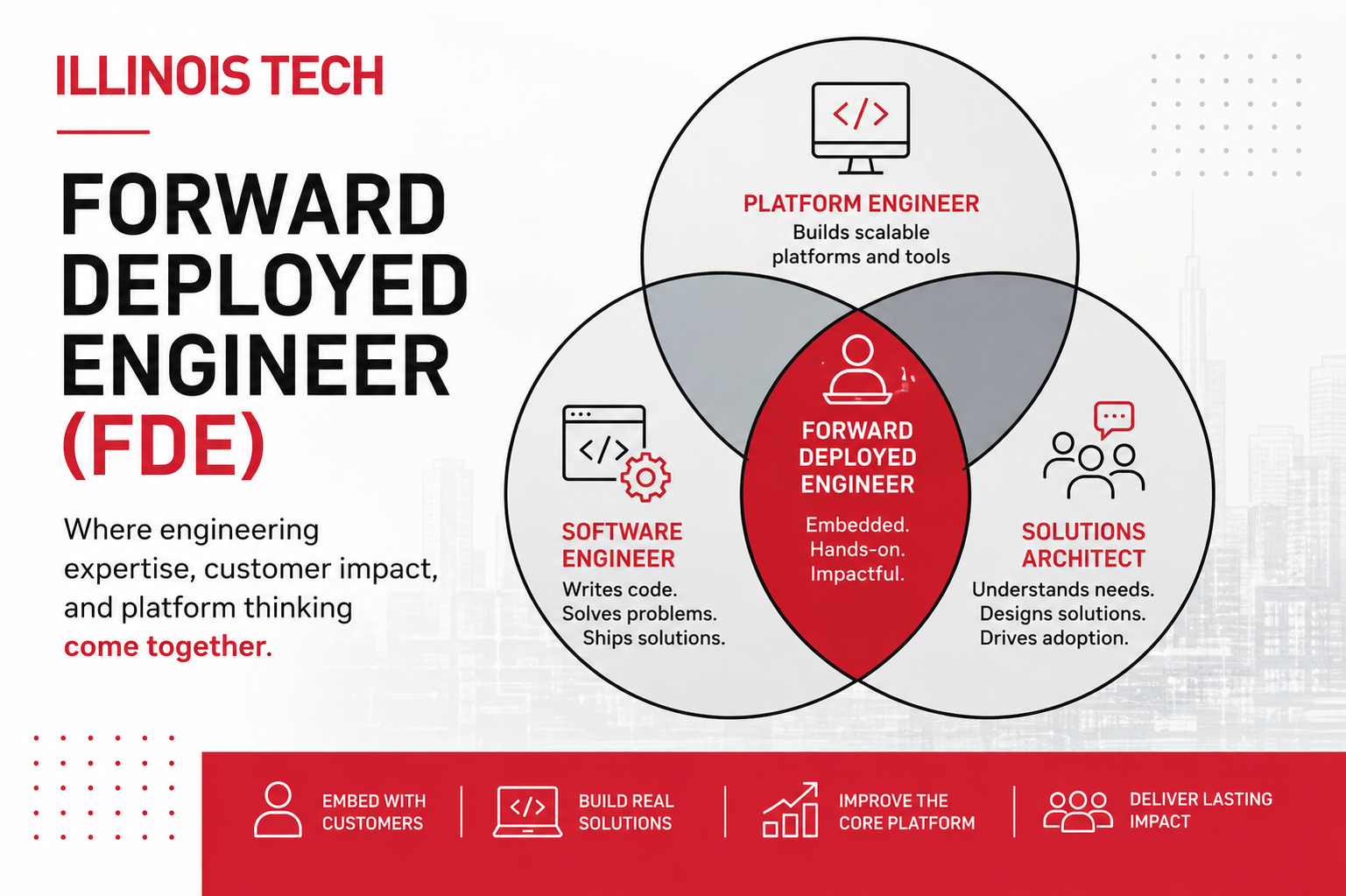
In short: A forward deployed engineer (FDE) is a software engineer who is embedded directly with a company's customers to design, build, and ship custom software—usually AI solutions—inside the customer's real-world systems while also feeding what they learn back into the core product. Think of it as part software engineer, part solutions architect, part consultant, and part startup CTO. It's one of the fastest-growing, highest-leverage jobs in technology in 2026, and it rewards people who combine strong engineering fundamentals with communication skills and business sense.
What is a forward deployed engineer?
The term was coined by Palantir, the data-analytics company known for its work with governments and large enterprises. The name borrows from the military, where a “forward-deployed” soldier is stationed in the field, close to the action and ready to respond. In tech, the FDE is deployed to a customer—sometimes literally sitting at the customer's site—to help them adopt complex software and solve real problems.
At Palantir, these engineers were originally called “Deltas,” and for years the company employed more Deltas than traditional software engineers. Palantir draws a useful distinction: a regular developer focuses on one capability across many customers, while a forward deployed engineer focuses on one customer across many capabilities. The developer builds a feature that serves everyone; the FDE does whatever it takes—writing code, wiring up data, configuring workflows—to make one customer successful.
That puts the FDE in an unusual spot on the organizational chart: somewhere between a back-office software engineer and a customer-facing solutions architect, closer to what some companies call a “field CTO.” As “The New Stack” frames it, FDEs don't just design a solution and hand it off—they stay hands-on through the entire customer lifecycle, fixing problems as they surface and adjusting systems based on what actually happens in the field.
What does a forward deployed engineer actually do?
No two companies define the role exactly the same way, but the day-to-day usually blends three kinds of work:
- Embedding with customers. FDEs spend real time on site or alongside customer teams to understand their domain, map their processes, and co-develop solutions in messy, evolving problem spaces. On-site expectations vary—Palantir has historically expected around 25 percent of an FDE's time with customers, while healthcare AI company Commure has estimated up to 50 percent.
- Building the solution. FDEs write production code inside the customer's actual infrastructure and tooling, not a sanitized demo environment. For AI work, that often means fine-tuning models, building retrieval-augmented generation (RAG) systems, and creating “evals” (quality checks that measure whether an AI system is accurate enough to trust).
- Improving the core product. When the company's platform can't do something a customer needs, the FDE builds it—and that improvement often flows back to every other customer.
A concrete example: OpenAI's forward deployed team worked with agriculture giant John Deere to scale personalized guidance for farmers. As detailed by “The Pragmatic Engineer” newsletter, an OpenAI FDE traveled to Iowa and worked directly with farmers ahead of a tight growing-season deadline. The solution shipped on time—and the work also improved OpenAI's Realtime API for every customer. Fintech company Ramp runs FDE “pods” tied to specific customers. Industrial-AI startup Matta expects its FDEs to scope solutions on the actual factory floor. And AWS's new FDE organization is already embedded with customers including the Allen Institute, Cox Automotive, the NBA, the NFL, Ricoh, and Southwest Airlines, helping the NFL launch fan products like NFL Fantasy AI and NFL IQ in weeks.
Palantir has summed up the scope memorably: an FDE's responsibilities resemble those of a startup CTO—small teams, high stakes, and end-to-end ownership.
If that scope-build-demo rhythm sounds familiar, it's the exact rhythm Illinois Tech students practice before they graduate. Through the university's signature Interprofessional Projects (IPRO) program, students from different majors form teams to solve real problems—often for sponsor companies and nonprofits—and then present live demos and working prototypes at each semester's Innovation Day. It's the same cycle an FDE runs with a customer: understand the problem, build a solution in the real world, and show the results to the people who have to live with them.
Why is the forward deployed engineer suddenly tech's hottest job?
The short answer is that AI is easy to demo and hard to deploy.
a16z puts it vividly: enterprises buying AI are “like your grandma getting an iPhone.” They want to use it, but they need someone to set it up. A polished model in a research laboratory is not the same as a working system inside a bank, a hospital, or a manufacturer, each with its own data, security requirements, legacy systems, and business logic. The gap between “cool AI demo” and “AI that reliably does the job” is enormous. Research bears this out: an MIT study in 2025 found that roughly 95 percent of enterprise AI pilots fail, largely because organizations' data is siloed and hard to integrate.
Forward deployed engineers exist to close that gap. a16z argues that the AI companies most likely to win are the ones willing to trade short-term profit margin for a long-term “moat”—doing the hands-on implementation work that makes their software indispensable, much as Salesforce, ServiceNow, and Workday did during the shift to cloud computing. When software stops merely assisting the worker and starts being the worker, someone has to onboard, manage, and continuously improve that digital labor. Increasingly, that someone is a forward deployed engineer.
The hiring data tells the same story. According to an analysis of 2026 tech hiring in “The New Stack that drew on Dice and CompTIA reports, more than half of tech job postings in the United States now require AI or machine learning skills—up sharply from about 29 percent a year earlier—and 84 percent of organizations plan to increase their AI investment. Carrol Chang, CEO of talent firm Andela, called the FDE “probably the hottest job in tech right now,” and offered a line that's become a rallying cry for the trend: companies, she said, need “FDEs, not FTEs.” A McKinsey projection she cited suggests the candidate pool for data-focused roles may cover only about half of expected demand.
In other words, the market has decided that the specialist who can make AI actually work inside a real business is worth a premium. Even model developers are competing for this talent. a16z noted that a meaningful share of OpenAI's open roles fall into forward deployed and solutions-engineering categories.
This is the shift Illinois Tech built its model around: pairing rigorous technical programs with guaranteed, hands-on experience so graduates can do the work on day one, not just describe it. In a hiring market that now prizes proven, production-ready specialists over generalists, that combination is exactly what employers are screening for.
How much do forward deployed engineers earn?
Compensation varies by company, location, and seniority, but forward deployed engineering is generally a well-paid, senior-leaning role, and packages often include variable pay tied to customer outcomes because the work sits so close to sales and revenue.
For context on the surrounding market, the U.S. Bureau of Labor Statistics reports a 2023 median salary of about $145,000 for computer and information research scientists (a role that typically requires a master's degree) and about $108,000 for data scientists, with data-scientist employment projected to grow 36 percent over the decade—far above the 3 percent average across all occupations. Because FDEs combine engineering depth with customer-facing impact, they frequently command compensation at or above senior software-engineering levels. (For a fuller look at the economics of AI careers, see our post on whether a master's in AI is worth it.)
Wherever an individual FDE role lands on the pay scale, it rewards exactly the profile Illinois Tech is built to produce—and the outcomes bear that out. Illinois Tech graduates earn starting salaries well above the national average, and the university ranks #1 in Illinois for graduates' eight-year median earnings (Carnegie Foundation/American Council on Education) and #22 in the nation for the salaries of its graduates (The Wall Street Journal, 2026). A big reason is Elevate, Illinois Tech's guarantee that every student can access hands-on experiences—internships, research, competitions, and more—before they graduate. As one student put it, “I wouldn't have a job lined up without Elevate.”
What skills do you need to become a forward deployed engineer?
This is where the role gets interesting, and where it differs from the prompt engineer, the AI job that captured headlines a couple of years ago. Prompt engineering leaned heavily on language and could be done with little coding. The FDE is a deeply technical role that also demands strong human skills. Successful forward deployed engineers tend to combine two toolkits:
Technical foundation
- Solid software engineering fundamentals and full-stack experience
- Applied AI and machine learning: model fine-tuning, RAG, evals, and LLM deployment
- Data engineering, because, as one MongoDB executive told “The New Stack,” models are becoming interchangeable and data is the real competitive edge
- Cloud infrastructure and security, especially for regulated industries like finance, healthcare, and government
- Rapid prototyping—AI tools now let FDEs put a working proof-of-concept in front of a customer fast
Human skills
- Communication and writing. FDEs live in ambiguity and have to translate vague business needs into technical specs. Good writing is now a competitive advantage, not a nice-to-have.
- Listening and empathy. The role runs on tight user-feedback loops. Google Cloud's DORA research has found that teams with a strong user-centric focus see about 40 percent higher organizational performance.
- Systems thinking and comfort with ambiguity. As Andela's Chang notes, the job rewards people who understand both the models and the enterprise—and who can build reinforcement loops that push an out-of-the-box system from "not good enough" to production-grade accuracy.
- Business sense. FDEs tie their work to measurable outcomes such as adoption, retention, ROI, and not just clean code.
Recruiters at a16z put it bluntly: this work doesn't require a Ph.D., but it does require hustle, curiosity, and a healthy disregard for the status quo.
Illinois Tech is deliberately structured to build both toolkits at once. On the technical side, students turn ideas into working prototypes fast in the Idea Shop, the university's hands-on making and rapid-prototyping space, the campus equivalent of putting a proof-of-concept in front of a customer. On the human and business side, aspiring builders can pressure-test a real product in Startup Studio at the Ed Kaplan Family Institute for Innovation and Tech Entrepreneurship, working through the venture-design process with mentors and pitching for a share of more than $50,000 at the annual Kaplan Pitch Tank. That's where the customer-obsessed, ship-it-fast, tie-it-to-outcomes instincts of forward deployment get forged. And because the role lives precisely where technical and human skills meet, Illinois Tech's Tech+ model—combining a technical major with a complementary, human-centered field in a single four-year degree—maps almost exactly onto what the job demands.
FDE vs. solutions engineer vs. AI engineer: what's the difference?
These titles overlap and companies use them loosely, but here's a rough map:
- Solutions engineer/solutions architect: More advisory. Often builds proofs-of-concept with sample data and rarely writes production code on the customer's systems.
- AI engineer: Focuses on building and integrating AI/ML systems but not necessarily embedded with a specific customer.
- Forward deployed engineer: The most hands-on of the three—embedded with a customer, writing production code in their environment, and contributing back to the core product. Adjacent titles you'll see include “agent engineer,” “implementation engineer,” “technical delivery engineer,” and “sales engineer.”
The through-line: the more an organization needs software to work reliably inside a messy, real-world environment, the more it needs forward deployed engineers.
How do you become a forward deployed engineer? (And how Illinois Tech prepares you.)
There's no single degree stamped “forward deployed engineer.” Instead, the role sits at the intersection of computer science, artificial intelligence, data, and business—exactly the interdisciplinary territory where Illinois Tech, Chicago's leading tech-focused university, has built its programs. In fact, that “one part technical, one part human” blend is the whole idea behind the Tech+ approach, which lets undergraduates combine a technical major with a complementary area of interest. Illinois Tech also has a long track record of producing people who shape this field: alumni have gone on to lead AI at the largest technology companies, including Rohit Prasad (M.S. '99), a senior AI leader behind Amazon's Alexa. Here's how to assemble the profile employers are hiring for.
Build the engineering and AI core. Start with strong computing and AI fundamentals:
- Computer Science (B.S.) and the M.S. or M.A.S. for full-stack engineering depth
- Artificial Intelligence (B.S.) and Artificial Intelligence (M.A.S.), covering machine learning, deep learning, NLP, computer vision, and probabilistic reasoning
- Data Science (B.S.), Data Science (M.A.S.), and the online Data Science with AI (M.A.S.), because clean, well-engineered data is what makes enterprise AI actually work
Add the systems, security, and infrastructure layer. FDEs deploy into real production environments, often in regulated industries. Relevant programs include Applied Cybersecurity and Digital Forensics (M.S.), Autonomous Systems and Robotics (M.S.) for those drawn to industrial and physical-world deployments, and Computational Decision Science and Operations Research (M.S.).
Bridge to the business. The FDE's customer-facing, outcome-driven side is what separates it from a pure engineering role. Programs that blend technology with management and communication are a natural fit: Information Technology and Management (B.A.C.) and its M.A.S., Business and Information Technology (B.S.), Business Analytics (M.S.), and the dual-degree Management (M.A.S.)/Computer Science (M.A.S.), a combination that maps almost perfectly onto the “engineer who thinks like a startup CTO” profile.
Sharpen the human skills. The user-centered, empathy-driven core of forward deployment is exactly what Illinois Tech's renowned graduate Design (M.Des.) program teaches directly. For students who want to weave AI understanding into a noncomputing major, the Artificial Intelligence (Minor) and the Critical AI (Minor) build fluency in how these systems work and where they can go wrong.
Get real-world reps. The single most repeated piece of advice from tech recruiters in 2026 is to build production-ready, real-world projects—“doing the job before you get the job.” Illinois Tech is designed around exactly that. Elevate guarantees every student access to experiential opportunities; IPRO puts multidisciplinary teams on real problems for real sponsors; the Idea Shop is where prototypes get built; and Startup Studio and TechForward help students turn deep-tech ideas into ventures. Career services and internships then connect students to Chicago's deep bench of enterprises in finance, healthcare, manufacturing, and logistics—the very industries now hiring FDEs to deploy AI. Learning in Chicago means you're already where the customers are.
International students, take note. Most of the computing, AI, and the data programs above are STEM-designated, which can make graduates eligible for extended Optional Practical Training in the United States, a meaningful advantage when you're launching a career in a fast-growing field.
Is the forward deployed engineer role here to stay?
Honest answer: the title may evolve. “The New Stack” points out that the FDE could follow the arc of the prompt engineer—white-hot for a moment, then reshaped as AI tooling matures and enterprise data silos break down. The role may also serve as a bridge that lets engineers try a more customer-facing path before returning to a lead- or platform-engineering role.
But the skills underneath it are durable. Connecting what you build to real business outcomes, listening to users, communicating clearly, and making complex systems work in the real world—those aren't going out of style. If anything, AI makes them more valuable, because the hard part of AI was never the demo. It was always the deployment.
That's a good bet to build a career on, and it's the bet Illinois Tech makes for every student: technical depth, real-world experience, and the human skills to put both to work.
Frequently Asked Questions (FAQs)
What does FDE stand for?
FDE stands for “forward deployed engineer,” a term coined by Palantir. Some companies use “forward deployed software engineer” or related titles like implementation engineer or solutions engineer.
Is a forward deployed engineer the same as a consultant?
Not quite. A consultant typically makes recommendations and leaves. An FDE embeds with a customer for the long term, writes production code in the customer's own systems, and also contributes improvements back to their company's core product.
Do you need to know how to code to be an FDE?
Yes. Unlike the prompt engineer role, forward deployed engineering is a deeply technical job that requires solid software engineering fundamentals plus applied AI/ML and data skills—paired with strong communication and business sense.
What companies hire forward deployed engineers?
Palantir pioneered the role. Today, it's in demand at OpenAI, Anthropic, Ramp, Salesforce, industrial and healthcare AI startups, and—following a $1 billion investment announced in 2026—Amazon Web Services, among many others.
What should I study to become a forward deployed engineer?
A strong foundation in computer science, artificial intelligence, or data science, ideally combined with coursework or experience in business, communication, and hands-on, real-world projects. Explore Illinois Tech's academic programs to build that mix.
Learn more
No matter where you are in your educational, professional, or personal journey, Illinois Tech provides you with a world-class, tech-focused education. You’ll be empowered through guaranteed access to hands-on experiences that prepare you with the innovation skills you need to thrive in the careers of the future. The results speak for themselves: Illinois Tech graduates have high employment rates and earn starting salaries well above the national average.
If you're ready to build toward one of tech's most in-demand careers, apply today, visit us in Chicago, or request more information.
Sources and further reading
- AWS, "AWS invests $1 billion to embed AI forward deployed engineers with customers" and the AWS Partner Network announcement
- Andreessen Horowitz (a16z), "Trading Margin for Moat: Why the Forward Deployed Engineer Is the Hottest Job in Startups"
- “The Pragmatic Engineer,” "What are Forward Deployed Engineers, and why are they so in demand?"
- “The New Stack,” "Why the forward-deployed engineer is tech's hottest job"
- “The New Stack,” "Tech Hiring in 2026: The Rise of the Specialist"