Important Update on 9/14/2026:
On Sept. 14, 2026, a federal judge issued a nationwide preliminary injunction blocking this Duration of Status rule from taking into effect. Implementation of the rule has been postponed pending further judicial action. OGS is monitoring this case and any further developments, and we will continue to provide updates as appropriate.
Illinois Tech’s Commitment
The Office of Global Services is actively monitoring federal guidance and implementation of this rule. We will continue to:
- Provide timely updates as new information becomes available
- Offer webinars and information sessions
- Update our FAQs and immigration guidance
- Assist students with individual advising and planning
- Work closely with academic departments to support affected students
Last Updated: July 23, 2026
The United States Department of Homeland Security (DHS) has published a final rule that changes how F-1 and J-1 status holders, including dependents, are admitted to and maintain status in the U.S. The rule is currently scheduled to take effect on September 15, 2026.
Illinois Tech is closely monitoring implementation of the rule, as well as any legal or regulatory developments that may affect its effective date. The Office of Global Services will continue to provide updated guidance as additional information becomes available.
What Is Duration of Status?
Under the current immigration system, most F-1 students are admitted to the United States for Duration of Status (D/S) rather than until a specific date. This allows students to remain in the U.S. for the duration of their academic program, any approved practical training (such as OPT or STEM OPT), and the applicable grace period, provided they maintain their F-1 status.
The new U.S. Department of Homeland Security rule replaces Duration of Status with a fixed period of admission reflected by an expiration date on a student’s Form I-94 (Arrival/Departure Record). Students who need additional time to complete their studies or authorized training may be required to apply to U.S. Citizenship and Immigration Services (USCIS) for an Extension of Stay before their authorized period expires.
Executive Summary
NAFSA: Association of International Educators summarizes the rule as making four fundamental changes:
- Replaces Duration of Status (D/S) with a fixed admission period reflected on the student’s Form I-94
- Requires students and exchange visitors who need additional time to file a USCIS Extension of Stay (Form I-539) rather than relying solely on a SEVIS program extension
- Reduces the F-1 post-completion grace period from 60 days to 30 days
- Introduces new restrictions affecting transfers, changes in educational objectives, and academic progression
Effective Date
- Published: July 17, 2026
- Effective: September 15, 2026 (60 days after publication), unless altered through litigation or Congressional Review Act action.
Major Changes:
1. Fixed Admission Period (AUD)
Instead of receiving Duration of Stay on the I-94, students admitted or changing to F or J status on or after September 15, 2026, will receive an Admit Until Date (AUD).
The AUD generally equals:
- Program end date on the Form I-20 or DS-2019
- Not to exceed four years
- A 30-day departure period
2. Introduction of Extension of Stay Application
F and J students and scholars who need to extend their AUD will be required to file an Extension of Stay (EOS) application with U.S. Citizenship and Immigration Services (USCIS) prior to their AUD’s expiration (but not more than 180 days before) or travel internationally and re-enter the United States to receive a new AUD.
Biometrics, provided in person at a USCIS Application Support Center, may be required as part of the EOS application.
The EOS application process will be required in addition to the extension of one’s I-20 or DS-2019.
EOS applications due to a delay caused by academic probation will not be an acceptable reason to extend the AUD. Academic probation in the context of this federal regulation is a wide-ranging immigration term that may include the “Academic Warning” and “Low GPA Warnings.”
Students and scholars will be allowed to continue their studies or research in the U.S. while they have an EOS application pending. Students and scholars will also be able to continue employment for at least 240 days provided the application was filed before the program end date.
Submission of an EOS application will be required as part of any Optional Practical Training (OPT) applications filed on or after March 18, 2027.
3. Transition Rules
Students already in the United States in Duration of Status on September 15, 2026:
- Do not immediately receive a new I-94
- Continue under transition provisions
- May remain until the earlier of:
- Their current I-20/DS-2019 program end date
- Four years from the rule’s effective date
- If they depart and re-enter after September 15, they will receive a fixed-date I-94
4. Grace Period Reduced
The post-completion F-1 grace period is reduced:
- Current: 60 days
- New: 30 days
This shortens the time that students have to depart, transfer, or change status after completing their studies or authorized practical training.
5. Restrictions on Educational Objectives for Students
The following restrictions are expected to take place on September 15, 2026. However, United States Citizenship and Immigration Services has indicated that implementation may be delayed. Additional communication from International Student and Scholar Services (ISSS) will be shared once the effective date is confirmed.
- Educational Objectives refers to a student’s educational level (bachelor’s, master’s, doctoral, etc.), major, field of study/research, or enrolled/host university
- Undergraduate students will be prohibited from changing educational objectives within their first year
- Graduate students will be prohibited from changing educational objectives at any point during their program
- Students may only pursue a subsequent degree at a higher level than the degree they previously obtained
Webinars and Information Sessions
D/S Webinar with Immigration Attorney
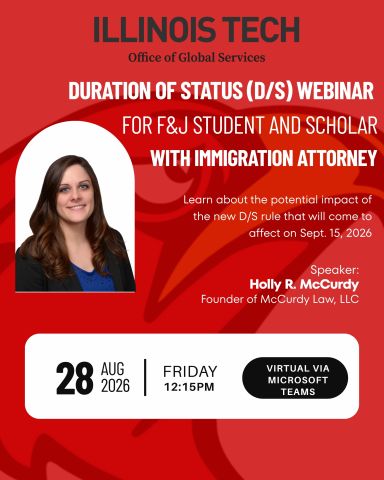
The Office of Global Services invites you to join an upcoming immigration webinar on the new DHS final rule ending Duration of Status (D/S) for F and J visa holders. We will be joined by immigration attorney, Holly R. McCurdy, who will discuss the new rule, what it means for F & J status holders, and what you should know as the September 15, 2026 effective date approaches. We encourage all international students and scholars to attend, especially students who are planning to graduate, apply for OPT, travel internationally, or extend their program.
- Friday, August 28, 2026
- 12:15-1:15 PM Central Time
- Virtual via Microsoft Teams— Join Via Webinar Link